If your windows look clear whilst wet but develop smears or pale spots as they dry, cleaning them again with the same cloth and solution may repeat the problem. The pattern of the marks often provides the first useful clue. This troubleshooting guide from Thames Face Clean helps you distinguish wiping residue, water spots and frame runoff so you can choose a more effective way to restore clear glass.
Windows usually look streaky after cleaning because detergent, dirt or dissolved minerals have been left on the glass. A contaminated cloth, uneven squeegee contact or cleaning solution drying too quickly can also leave marks. The most effective fix depends on the pattern you can see.
Before cleaning the whole window again, take a closer look at one affected area.
Read the Marks Before You Reclean the Window
“Streaky” can describe several different problems. Identifying the type of mark helps you avoid repeating a method that is causing it.
| What you see | Possible explanation | What to check first |
|---|---|---|
| Broad, cloudy smears | Cleaner residue, grease or a contaminated cloth | Does a clean, lightly dampened cloth change the mark? |
| Narrow lines following the cleaning direction | Uneven squeegee contact or wiping marks | Is the blade clean, straight and undamaged? |
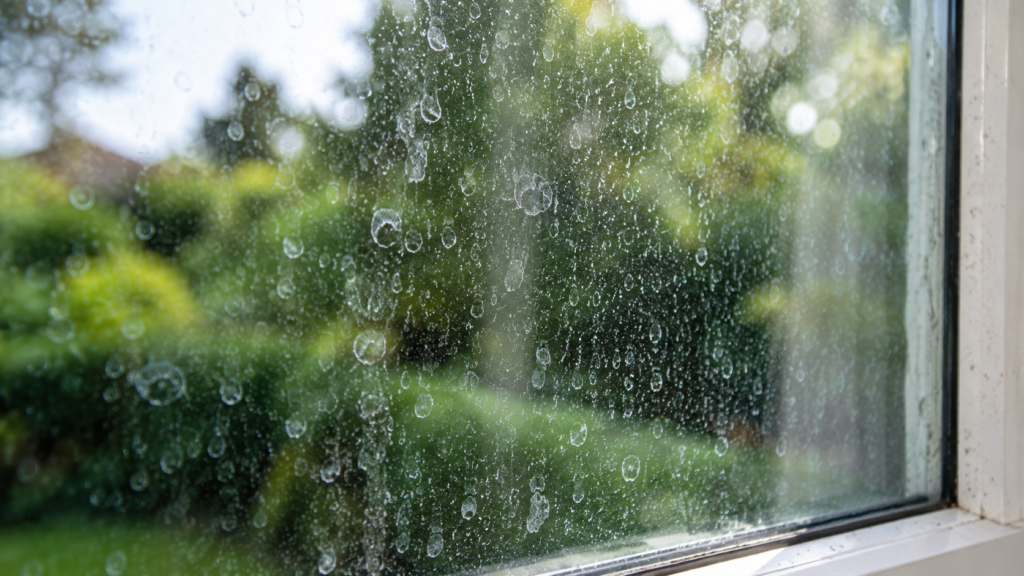
| Small pale spots or droplet outlines | Mineral deposits or contaminated rinse water | Were the windows left to dry after rinsing with tap water? |
| Drips starting beneath the top frame | Dirty water running from frames or seals | Were the upper frame and edges cleaned first? |
| Haze visible mainly in low sunlight | A thin film of residue or dirt | Have both accessible sides of the glass been checked? |
| Cloudiness that cannot be reached from either side | Possible moisture within a sealed glazing unit | Does the mist appear to sit between the panes? |
These are starting points, rather than a diagnosis from appearance alone. A window can have more than one issue: greasy marks indoors and mineral spots outside, for example.
Too Much Cleaning Product Can Leave More Work Behind
More detergent does not necessarily mean cleaner glass.
If the solution is stronger than required, it can leave a film that needs further removal. Repeatedly spraying a nearly clean pane can also introduce fresh residue each time you polish it.
A useful clue is a smear that moves or changes shape as you wipe. Instead of lifting it away, the cloth may be redistributing the remaining cleaner.
How to Correct It
For ordinary, uncoated glass, use a suitable cleaning product at its recommended dilution. Work on a small section and remove the solution completely with a clean squeegee or lint-free cloth.
Avoid combining several household products in an attempt to improve the result. If the window has a coating, applied film or specialist finish, follow its care instructions.
The aim is to remove the dirt and the cleaning solution together.
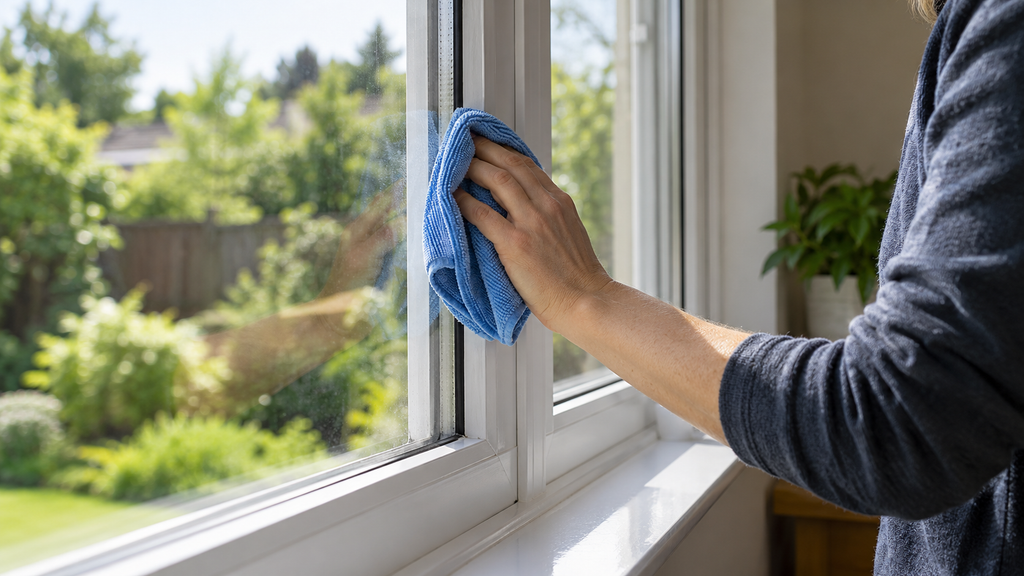
Your Cloth May Be Putting Residue Back on the Glass
A cloth can look clean while still holding grease, detergent or dirt from an earlier task.
Using the same cloth on frames, sills and glass is a common way to transfer contamination. Once the fabric becomes saturated, each pass can leave a faint trail.
Microfibre can work well, but the material alone does not guarantee a clear finish. Its cleanliness and condition matter just as much.
A Better Cloth Routine
Keep separate cloths for:
- Frames and sills.
- Washing or wiping the glass.
- Finishing edges and removing small remaining marks.
Change to a fresh cloth when the current one becomes dirty or too damp to finish effectively. Wash reusable cloths according to their care instructions and avoid laundry treatments that leave an unwanted coating.
If a previously troublesome pane cleans well with a fresh cloth, the original cloth was probably contributing to the problem.
Hot Glass Makes Cleaning Solution Dry Too Quickly
A sunny afternoon may seem ideal for window cleaning, but a warm pane can be difficult to finish evenly.
Water and cleaning solution may dry before you remove them, leaving visible edges, overlapping wipe marks or patches of residue.
This can happen even when the air feels fairly cool. A window exposed to direct sun may be much warmer than one on the shaded side of the house.
Change the Timing, Then the Technique
Clean when the glass is cool, preferably out of direct sunlight. Work on one manageable pane or section at a time.
Apply enough solution to clean effectively, then remove it before it dries. If a section has already dried with residue on it, re-wet it with a suitable solution rather than repeatedly rubbing the dry deposit.
A slower drying window gives you more control over the finish.
Tap Water Can Leave Spots as It Evaporates
If windows are rinsed with tap water and left to dry, dissolved minerals can remain after the water has evaporated.
The result is often a pattern of pale dots or droplet-shaped marks. These differ from the long lines commonly associated with a squeegee.
This is relevant in hard-water areas, including many parts of London and the South East. It can also explain why a pane looks clear whilst wet but develops spots as it dries.
How to Avoid Repeating the Problem
With a traditional cleaning method, remove the wash water effectively rather than leaving ordinary tap water to evaporate on the glass.
Professional pure-water cleaning takes a different approach: water is treated to reduce dissolved impurities, allowing properly cleaned and rinsed glass to dry without conventional towel drying.
For recurring exterior spotting, our window cleaning services provide a way to arrange an assessment of the glass and the cleaning method suited to it.
Existing mineral staining may need separate treatment. Do not assume that every established deposit will disappear during a routine wash.
A Squeegee Can Leave Lines Even When the Glass Is Clean
A squeegee works by maintaining consistent contact with the pane and removing the liquid in its path.
A small particle on the rubber edge, a nick in the blade or uneven pressure can interrupt that contact. The remaining water then dries as a narrow line.
If the same line appears repeatedly in a similar position during each pass, inspect the tool before changing the cleaning solution.
Check These Three Things
The rubber edge: Remove trapped dirt and replace damaged or worn rubber.
The contact: Keep the blade against the glass evenly, including near the ends.
The finish: Remove water left around the perimeter with a separate clean cloth, taking care not to drag dirty frame water back across the pane.
Polishing the whole window afterwards should not be necessary simply to compensate for a blade that is leaving water behind.
Dirty Frames Can Spoil a Clean Pane
Sometimes the glass looks good immediately after cleaning, then develops drips from the top.
Water can pick up dirt from frames, seals and surrounding details before running onto the finished pane. Cleaning only the middle of the glass leaves that source of contamination in place.
This is particularly noticeable when a neglected frame receives a thorough wet clean.
Work from the upper frame towards the glass, using tools and methods appropriate to the window. Avoid washing dirt from higher sections over an area you have already finished.
Where conservatory glazing has the same problem, the roof edges, frames and adjoining sections may all influence the result. Our conservatory cleaning services explain the related service for these more complex structures.
Why Can Windows Look Marked After Pure-Water Cleaning?
Pure-water cleaning does not mean that every wet pane will automatically dry perfectly.
The water needs to be sufficiently pure, the brush must be clean, dirt must be loosened properly and the final rinse must remove it. Contaminated equipment, inadequate rinsing or runoff from dirty frames can affect the finish.
Old detergent residue may also require additional attention when changing from traditional cleaning to a pure-water method.
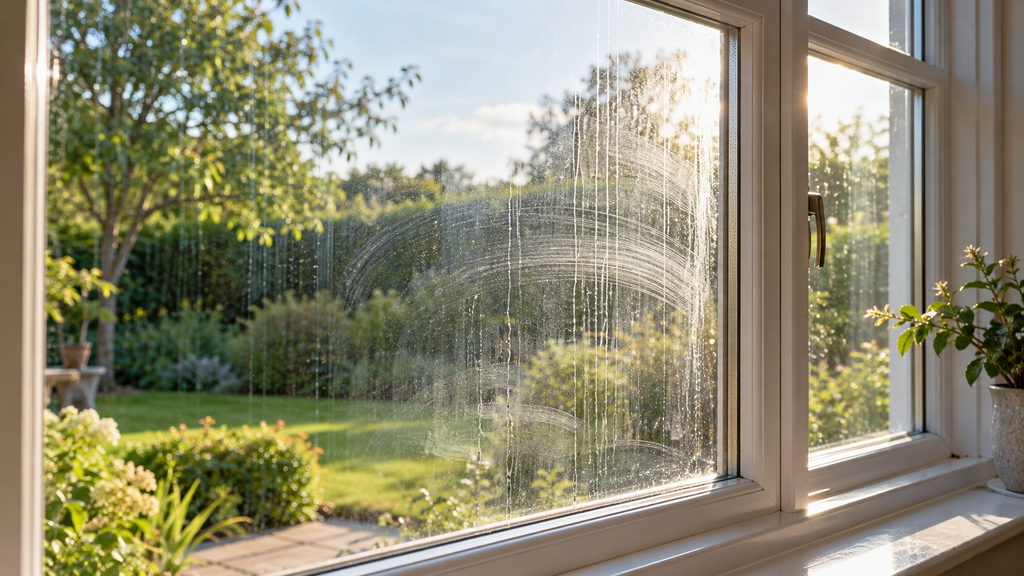
Should You Dry the Windows with a Towel Afterwards?
A correctly completed pure-water clean is normally intended to air-dry. Wiping the wet glass with a household cloth can introduce fresh contamination.
Allow it to dry fully before assessing the result. If marks remain, photograph them and note whether they are spots, drips from the frame or a general film.
Do not accept persistent marks as unavoidable simply because a water-fed pole was used. Equally, droplets on glass that is still drying are not proof of a poor finish.
Check Whether the Marks Are Indoors, Outdoors or Between the Panes
A clean exterior can make an interior film easier to notice.
Fingerprints, cooking residue and other indoor contamination may remain even after the outside has been washed. Cleaning one face of the glass cannot remove marks on the other.
For safely accessible windows, inspect the pane from both sides. A small test clean can help establish where the mark sits.
When the Cloudiness Is Inside the Glazing Unit
If misting appears between the panes of a sealed double-glazed unit, surface cleaning cannot reach it. This can indicate a failed seal and needs assessment by a glazing professional.
Condensation on an accessible room-facing or outdoor surface is different. Its position matters, so avoid diagnosing a failed unit solely because the window looks cloudy.
A Practical Reset for a Streaky Window
For an ordinary, safely accessible pane without specialist cleaning restrictions, use this sequence before tackling the rest of the property.
- Identify the affected side.
Check whether the mark is on the inside, outside or apparently within the glazing. - Wait until the glass is cool.
Avoid a pane being heated by direct sunlight. - Prepare the surrounding frame.
Remove loose contamination without dragging gritty material across the glass. - Use fresh equipment.
Start with a clean applicator, an undamaged squeegee and separate finishing cloths. - Apply a suitable cleaner correctly.
Follow the product dilution and the window manufacturer’s care guidance. - Remove the dirty solution.
Work methodically so it does not dry in patches. - Finish the edges and inspect after drying.
Look from an angle as well as straight through the glass.
If the test section improves, repeat the same controlled method across the remaining panes. If the mark stays in exactly the same place, reassess it before applying stronger products.

Marks That May Need More Than Routine Cleaning
Some defects resemble cleaning residue but do not respond to a normal wash.
Examples include persistent mineral deposits, construction residue, scratches, coating damage and cloudiness within a sealed unit.
Avoid treating an unidentified mark with an abrasive pad, blade or strong chemical. A method that suits ordinary glass may damage a coating, film, frame or seal.
For self-cleaning glass and other specialist products, use the manufacturer’s approved maintenance instructions. The phrase “self-cleaning” does not mean that any cleaning product or tool is suitable.
What to Tell a Professional Window Cleaner
A useful description is more specific than “the windows are streaky”.
Explain:
- Whether the marks are inside or outside.
- Whether they appear immediately or only after drying.
- Whether they start beneath the frame.
- Whether they look like lines, greasy smears or pale spots.
- What products or methods have already been used.
- Whether the glass has a coating or applied film.
Photographs taken after the pane has dried, especially with light falling across it, can help show the pattern.
For properties in Twickenham, Richmond, Teddington and surrounding West and South West London areas, Thames Face Clean offers exterior cleaning and free, no-obligation quotations. Share your postcode, photographs and a description of the marks so the scope of the work can be discussed.
Frequently Asked Questions
Why do my windows look worse after I clean them?
Cleaning may have spread existing grease or left detergent, dirty water or wiping residue behind. A change in light can also reveal marks that were difficult to see whilst the pane was wet.
Why are streaks more visible in sunlight?
Light striking the glass at an angle makes small differences in the surface film easier to see. Sunlight can reveal residue, and cleaning hot glass can also cause the solution to dry too quickly.
Is washing-up liquid suitable for cleaning windows?
Some window manufacturers permit mild soapy water for ordinary glass. Use a suitable dilution and remove the solution thoroughly. Check specific instructions for coated glass, films, frames and seals.
Will vinegar remove every window streak?
No. It will not correct a damaged squeegee, a dirty cloth, scratches or moisture trapped between panes. Product suitability also varies, so avoid treating vinegar as a universal solution.
Can you get a clear finish without a squeegee?
Yes, on suitable accessible glass, a clean lint-free cloth and an appropriate cleaner can work well. The important part is removing dirt and residue without spreading them around.
Does rain make clean windows streaky?
Rain can carry contamination or move dirt from surrounding frames onto the glass. The result depends on what the water contains and what it passes over; rainfall does not automatically mean that a clean window needs washing again.
Why do white spots remain after window cleaning?
Mineral deposits are one possible cause, particularly when tap water has dried on the surface. Residual contamination can also produce spots. Persistent marks should be identified before specialist treatment is attempted.
How can I tell whether a mark is permanent?
A mark that remains after a careful, appropriate test clean needs closer assessment. It may be a stubborn deposit, a scratch, coating damage or an issue within the glazing. Its persistence alone does not establish which one.