
A coloured patch on a rendered wall can leave you wondering whether the surface needs cleaning, repainting or repair. Green growth beside a shaded hedge, reddish streaks beneath a window and dark marks near a gutter may have different causes. In this guide, Thames Face Clean explains how to assess render discolouration, recognise the conditions behind it and choose an appropriate next step.
Green and red staining can be associated with algae, whilst black discolouration may involve biological growth, dirt or pollution deposits. Colour alone cannot identify the cause. The location of the marks, how the wall dries and the condition of the render are equally important.
Before choosing a cleaning product, look at the whole elevation. A stain often tells you something about the water, shade or contamination reaching that part of the building.
What Each Colour Can Tell You
The following patterns can help guide an inspection. They should not be treated as a definitive diagnosis from a photograph.
| Appearance | Possible explanation | Useful clues |
|---|---|---|
| Green film or patches | Algae or other surface growth | Shaded areas, nearby vegetation and surfaces that stay damp |
| Red or orange discolouration | Algal growth or staining from another source | Whether it spreads across the surface or follows a metal fitting |
| Black or dark grey patches | Biological growth, accumulated dirt or pollution | Surface texture, exposure and the position of runoff |
| Dark vertical streaks | Water carrying contamination down the wall | Gutters, outlets, sills and details immediately above |
| Localised rust-coloured trail | Possible corrosion-related staining | Metal fixings, railings or fittings near the starting point |
| A patch that darkens in rain and fades as it dries | Uneven wetting or moisture retention | Whether it dries with the surrounding render |
More than one process can affect the same wall. For example, a leaking gutter may create a damp track that later develops biological growth.
Why Render Turns Green
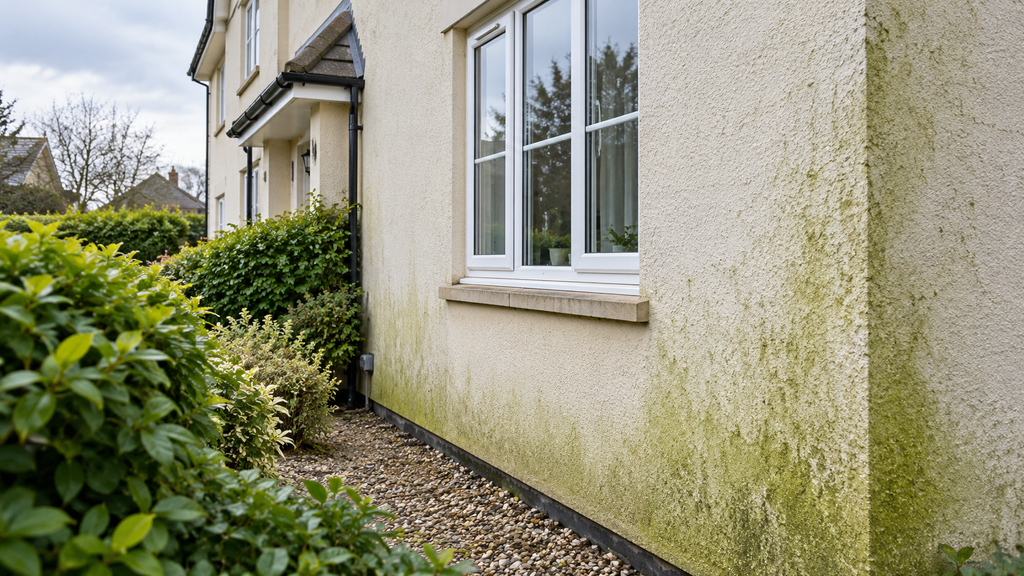
Green discolouration is commonly associated with algae growing on the surface.
A rendered wall does not need to be permanently soaked for growth to establish. Repeated wetting, surface condensation and slow drying can create favourable conditions.
Weber identifies north-facing elevations and properties near woodland or water as more susceptible to algae. Prolonged mild, damp weather can also encourage growth on many exterior materials.
Why One Wall May Be Worse Than the Others
Different sides of a house experience different conditions.
A shaded side passage may receive little direct sunlight. A wall beside a mature hedge may dry slowly. Another elevation may catch more wind and dry relatively quickly after rain.
This explains why one section can look green whilst the front of the property remains relatively clean.
Inspect the surroundings as well as the render:
- Does vegetation sit close to the wall?
- Is the affected area sheltered from moving air?
- Does it receive runoff from a roof or window detail?
- Does the same patch stay visibly wet after neighbouring areas have dried?
These observations help identify why growth is concentrated in a particular place.
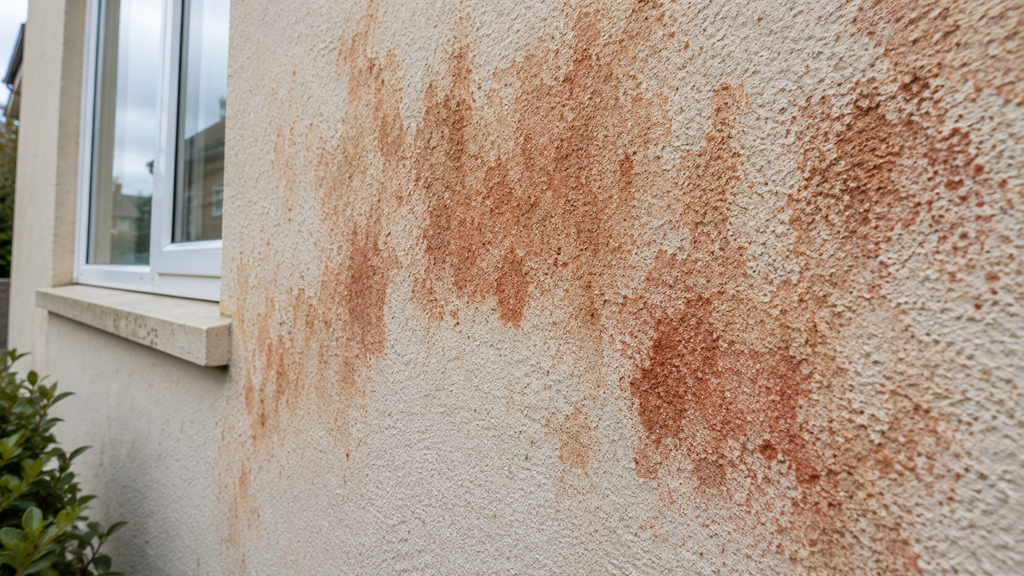
Why Render Develops Red or Orange Stains
Red staining can be biological. Algal growth on rendered walls is not limited to green, and manufacturers recognise red algae as a maintenance concern.
However, an orange or rusty colour does not automatically mean algae.
A narrow trail beginning beneath a metal fitting deserves a different assessment from a broad reddish film spreading across an elevation.
Look for the Starting Point
Follow the stain upwards from ground level.
If the mark begins at a fixing, bracket or other metal detail, investigate that component before arranging general algae treatment. If the staining is more widespread, biological growth may be one possibility.
The distinction matters because a treatment selected for organic growth may not address a corrosion-related deposit.
Avoid repeatedly applying stronger cleaner simply because the first product has made little difference. An ineffective treatment can indicate that the original diagnosis was wrong.
Why Render Turns Black
Black marks are particularly easy to misidentify.
Dark discolouration can involve biological growth, airborne dirt, pollution or contamination washed from another part of the building. A black patch is not enough to identify a particular mould species.
The shape and distribution of the marks provide useful context.
Broad Darkening Across an Elevation
A wall facing a busy road may accumulate different deposits from a sheltered garden elevation. Dirt can also become more noticeable on pale or textured finishes.
Cleaning should be selected for both the contaminant and the render system. A product intended for algae is not automatically the complete answer to every dark deposit.
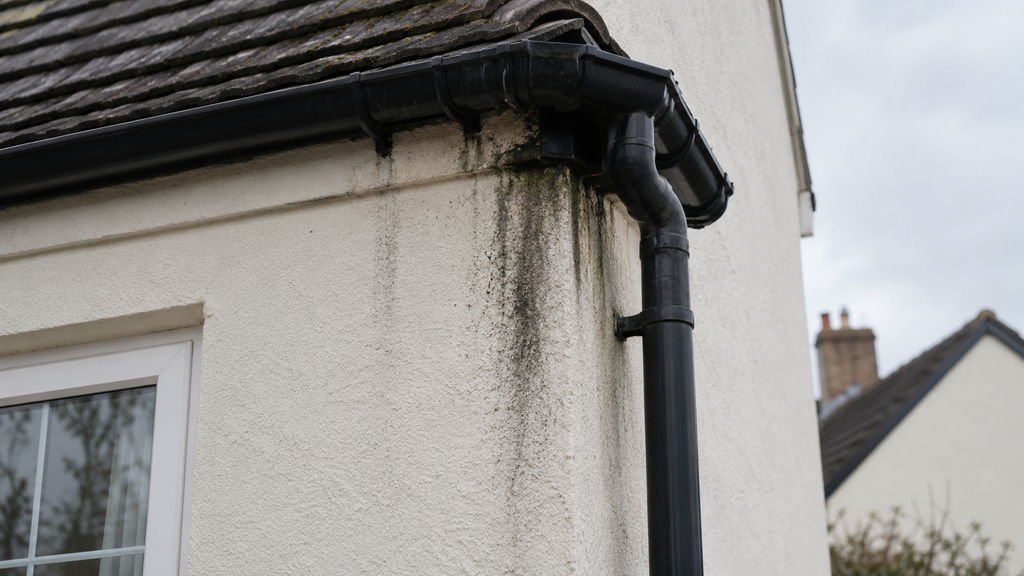
Streaks Beneath Gutters and Window Sills
Vertical marks often justify an inspection of the detail above them.
Overflowing gutters, leaking joints or concentrated runoff can repeatedly carry water and contamination down the same route.
If a gutter is contributing to the staining, cleaning the wall without addressing the overflow may give only a temporary improvement. Our gutter cleaning services provide a relevant starting point where debris or a suspected blockage is affecting rainwater flow.
A damaged gutter fitting or poorly functioning building detail may require a separate repair.
Does Discoloured Render Mean the Wall Is Damaged?
Not necessarily.
Surface algae can be an appearance and maintenance issue without indicating failure of the render. K Rend and Weber both distinguish algal growth from deterioration in the render’s underlying performance.
However, this does not mean every stained wall is sound.
Discolouration should be assessed alongside any cracking, loose material, failed coatings or persistent moisture symptoms.
Arrange Further Assessment If You Notice:
- Cracks that are widening or repeatedly reopening.
- Render that is loose, bulging or falling away.
- A concentrated wet patch associated with a visible leak.
- Corresponding damp marks on the inside of the building.
- Staining that returns quickly along the same water path.
These signs may call for a renderer, surveyor, roofer or another appropriate specialist.
Cleaning can improve the surface appearance. It cannot repair a failed detail or establish the cause of internal damp on its own.
Surface Dampness and Water Ingress Are Different Questions
An exterior wall can become wet during rain without having a water-ingress defect.
Equally, a localised leak may keep one area wetter than expected.
The useful question is whether the moisture pattern fits the exposure of the wall.
For example, general darkening during rainfall followed by reasonably even drying is different from a single persistent track beneath a gutter joint.
Photographs taken during rain and again after a dry period can help document the pattern. They provide useful evidence for an assessment, although they do not replace an inspection.
Avoid diagnosing rising damp, penetrating damp or a failed render system from colour alone.
How Should Green, Red or Black Render Be Cleaned?
Start by identifying the render and its condition.
“Render” covers several systems, including cement-based finishes, monocouche, thin-coat silicone systems, lime render and painted surfaces. Their maintenance requirements are not interchangeable.
Manufacturer guidance should determine the suitable products and cleaning method.
A Sensible Cleaning Assessment Includes:
- Identifying the surface
Establish the render system, any coating and relevant maintenance instructions. - Assessing the staining
Consider biological growth, dirt, runoff and possible metal-related deposits. - Checking for defects
Identify areas that need repair or investigation before washing. - Testing the proposed treatment
Use a discreet area to assess compatibility and the likely result. - Planning the application and finish
Follow the selected product’s requirements for dilution, contact time, weather conditions and rinsing.
Biological staining may respond to an appropriate render-compatible treatment. The method should address the actual surface condition rather than rely on aggressive washing.
Our soft washing services explain the related approach to cleaning suitable exterior surfaces with controlled application and appropriate treatment.
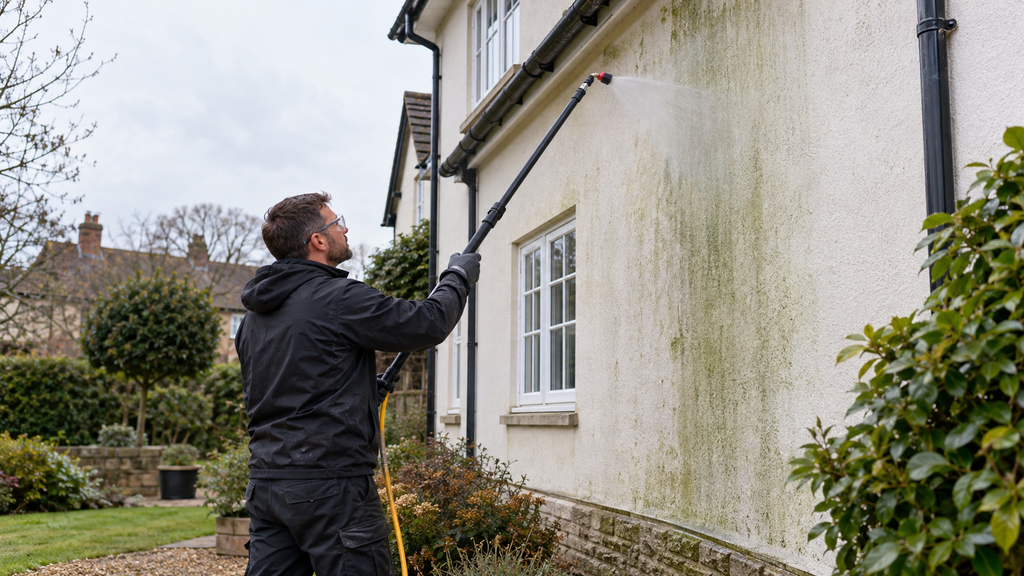
Can You Pressure Wash Render?
There is no single answer for every finish.
Some manufacturers permit controlled washing on specified render products, with suitable pressure, nozzle selection and technique. That permission should not be extended to an unidentified or damaged wall.
Weber, for example, warns that a concentrated jet can damage render and states that pressure washing is unsuitable for dry dash finishes.
The objective is to remove contamination whilst preserving the surface.
A domestic pressure washer used close to the wall can leave visible cleaning tracks or damage vulnerable areas. If the render system is unknown, establish what it is before choosing the equipment.
Should You Use Bleach on Stained Render?
Avoid treating household bleach as a universal render cleaner.
A product needs to be suitable for the render, coating and surrounding materials, with clear instructions for application and any rinsing required.
Some professional exterior treatments use chlorine-based chemistry, but that does not make an improvised household mixture equivalent to a specified cleaning process.
Never mix cleaning products. In particular, bleach must not be mixed with acids or ammonia-containing cleaners.
For biological staining, ask which render-compatible product is proposed and why it suits the surface. A stronger concentration is not automatically a better treatment.
Will Cleaning Restore the Original Colour?
Cleaning can remove contamination that is masking the finish, but an exact return to the original appearance cannot be promised.
The result depends on what has changed.
Dirt and biological growth are different from fading, coating deterioration, previous repairs or permanent staining. Once contamination is removed, older repair patches may become more noticeable.
A test area helps set realistic expectations.
Ask whether the expected outcome is:
- Removal of surface dirt.
- Treatment of biological growth.
- Reduction of a particular stain.
- Preparation for a separate coating or repair.
A clear description of the intended result is more useful than a general promise to make the wall “look new”.
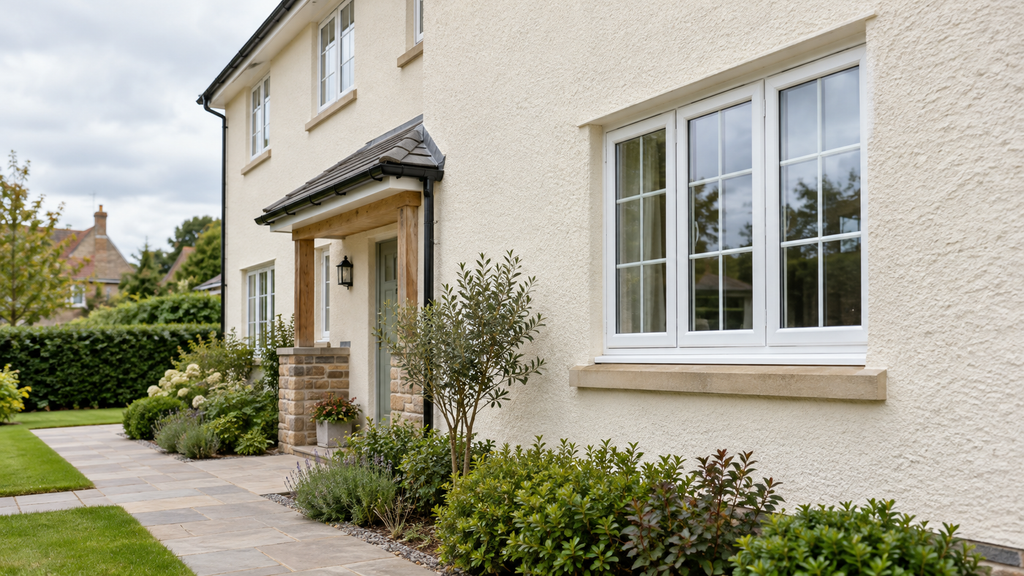
Should You Paint Over the Stains?
Painting should follow an assessment of the surface and the cause of the marks.
Applying paint over contamination or unresolved defects can leave the underlying problem in place. A new coating also needs to be compatible with the render system.
Where a coating is appropriate, preparation may involve cleaning, treatment, repairs and drying in accordance with the manufacturer’s specification.
Repainting is a separate decision from cleaning. A wall with surface growth may not need a colour change, whilst a deteriorating painted finish may require more than a wash.
How to Reduce the Chance of Staining Returning
Exterior surfaces remain exposed to weather and airborne contamination, so permanent prevention is unrealistic.
However, it is sensible to address conditions that repeatedly wet or contaminate the same area.
Useful maintenance includes:
- Keeping rainwater outlets functioning.
- Repairing leaking gutters and downpipes.
- Managing vegetation that rests against the wall.
- Keeping soil and garden debris away from the render finish.
- Checking recurring runoff tracks.
- Following the render manufacturer’s maintenance guidance.
Where a protective treatment is proposed, confirm its compatibility with the existing system. A coating should not be used to conceal a moisture or repair problem.
The maintenance interval should reflect the property’s exposure and condition. A shaded elevation may need attention sooner than a more exposed wall on the same building.
Requesting an Assessment for Stained Render
Useful photographs show more than a close-up of the colour.
Include a full view of the affected elevation, the details above the stain and any nearby vegetation. Mention whether the marks change after rain, whether the wall has been cleaned before and whether you know the render brand or system.
For homes in Twickenham, Richmond, Teddington and surrounding areas, an initial assessment can help establish whether the next step is cleaning, maintenance or further investigation.
Ask for a quotation that identifies the treatment area, proposed method, access requirements and any limitations on the expected finish.
Frequently Asked Questions
Is green algae on render a sign of poor installation?
Not by itself. Algae can develop on exterior surfaces because of environmental conditions, including shade and prolonged damp weather. Installation or building-detail issues require separate evidence.
Why is my white render turning red?
Red algal growth is one possibility. Rust-related staining or another deposit may also produce a reddish appearance. The location and pattern should be assessed before treatment.
Are black marks on render always mould?
No. Dark marks can involve biological growth, dirt, pollution or contaminated runoff. Colour alone cannot identify the material or a particular species.
Does silicone render need cleaning?
It can. A low-maintenance finish is still exposed to weather, dirt and biological contamination. Follow the specific system’s care instructions.
Can algae grow on water-repellent render?
Yes. Water repellence does not make a surface immune to biological growth, particularly where environmental conditions favour it.
Why does staining keep coming back beneath one gutter?
Repeated wetting or contamination from the gutter may be contributing. Check for overflow, blockage or a leaking joint rather than repeatedly cleaning the wall alone.
How long will render stay clean after treatment?
There is no reliable period that applies to every property. Exposure, shade, nearby vegetation, surface condition and the treatment used all influence the result.
Can I clean render myself?
Small, safely accessible areas may be suitable for maintenance using the manufacturer’s approved instructions. Unknown finishes, high-level work, significant staining or damaged render are better assessed before treatment.
When should I contact a repair specialist instead of a cleaner?
Arrange further assessment if staining accompanies loose render, significant cracking, recurring leaks or internal damp. Those symptoms may require investigation beyond surface cleaning.