Composite decking needs a cleaning method that suits its surface, not simply the strongest cleaner available. Dirt trapped in the grain, greasy barbecue spills and green growth can require different treatment, whilst an unsuitable brush or concentrated water jet may leave lasting marks. This guide from Thames Face Clean explains how to clean composite decking methodically, choose compatible products and recognise when a mark needs specialist advice.
For routine cleaning, identify the decking product first, remove loose debris, then use the manufacturer-approved cleaner and brush. Work in manageable sections, rinse thoroughly and inspect the boards after drying. Only use a pressure washer where the instructions for your particular decking permit it.
The most important precaution happens before you start: establish exactly what you are cleaning.
Before You Pick Up a Brush, Identify the Boards
Composite decking is a broad product category. Many boards contain a mixture of wood fibres and plastic, and some have a protective outer cap. Other decking products use different polymer or mineral-based constructions.
Even products from the same manufacturer can have different care requirements.
Instructions for a current capped board may not apply to an older uncapped range. Likewise, a cleaning method suitable for timber should not automatically be used on composite.
Look for the product name in:
- Installation invoices or warranty paperwork.
- Receipts from the supplier.
- Spare boards or packaging.
- Information held by the installer.
If you cannot identify the boards, avoid pressure washing or applying specialist stain removers until you have suitable advice.
A hidden test patch is useful, but it does not replace checking whether the method is approved.

What You Need for a Routine Clean
For most straightforward cleaning jobs, the equipment list is modest:
| Item | What to look for |
|---|---|
| Broom | Non-abrasive bristles suitable for removing loose debris |
| Cleaning brush | The type specified for the decking product |
| Cleaner | A manufacturer-approved product or mild detergent where permitted |
| Bucket | Clean, without residue from previous chemicals |
| Garden hose | A controlled rinse rather than a concentrated jet |
| Cloth | Suitable for blotting spills and cleaning small areas |
| Protective equipment | As required by the cleaner’s label |
Brush selection deserves particular attention. Some surfaces tolerate a firmer brush, whilst others can lose their sheen or develop visible abrasion.
Do not assume that a tool sold as a “decking brush” suits every composite board.
How to Clean Composite Decking: Step by Step
1. Clear the Area Without Dragging Furniture
Lift furniture, plant pots and accessories where practical. Dragging heavy items across dirty boards can pull trapped grit along the surface.
Check beneath pots and mats for accumulated debris, standing moisture and localised staining. Keep an eye out for damaged boards or loose components that need attention before cleaning.
Plan where the rinse water will go, particularly if the deck sits beside planting, a pond or another sensitive area. Follow the cleaner’s instructions for protecting its surroundings.
2. Sweep Away Leaves, Grit and Loose Dirt
Remove loose material before introducing water.
Wet leaves and soil can spread across the boards during washing, making the work harder. Grit can also become trapped beneath a brush.
Pay attention to corners, steps, the area beneath furniture and the spaces beside planters.
Clear accessible gaps gently using a suitable non-damaging tool. Avoid forcing sharp metal implements between the boards or disturbing concealed fixings.
If water repeatedly pools in the same place, cleaning alone may not resolve the drainage issue.
3. Test the Cleaner and Brush Together
Choose a discreet area and follow the product instructions.
A useful test checks the whole method: cleaner, dilution, brush, contact time and rinsing. Let the test area dry before judging the result.
Stop if you notice a change in colour, gloss or texture. Do not continue across the deck in the hope that the appearance will become uniform.
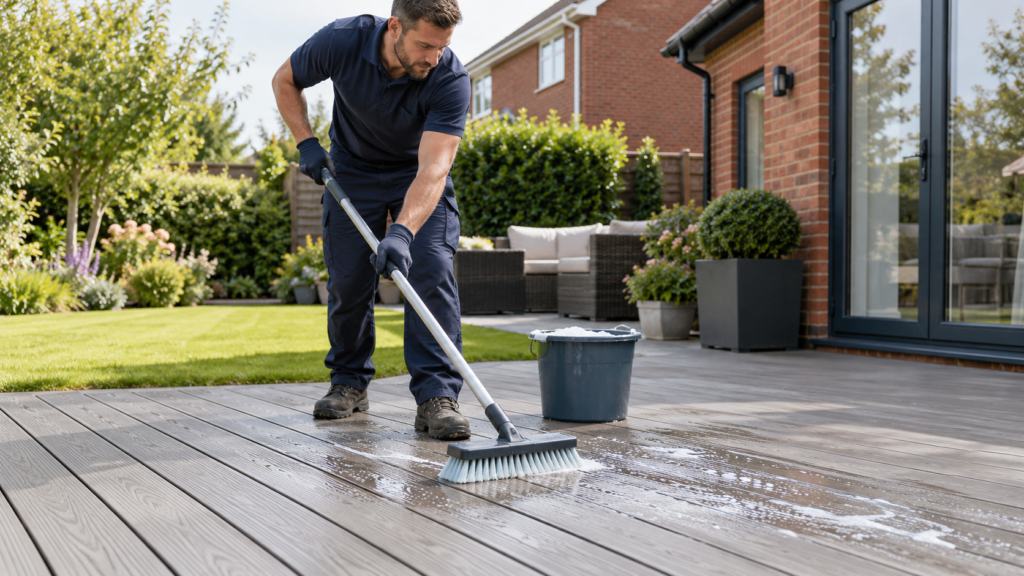
4. Wash a Manageable Section
Apply the approved cleaning solution as directed. Use the specified brush to loosen dirt from the surface texture.
Where the manufacturer recommends brushing along the grain, follow that direction. Avoid increasing force simply because the first pass has not removed an established stain.
Work in sections small enough to complete before the cleaning solution dries. Cool conditions and a shaded surface usually make the process easier to control.
Do not allow concentrated cleaner to sit in puddles unless the instructions specifically require it.
5. Rinse Away the Dirty Solution
Rinsing is part of cleaning, rather than an optional finishing step.
Work systematically so loosened dirt and cleaner are carried off the boards. Avoid washing dirty water back over a section you have already completed.
A film left after drying may be cleaning residue or redistributed dirt. It does not necessarily mean the boards need a stronger chemical.
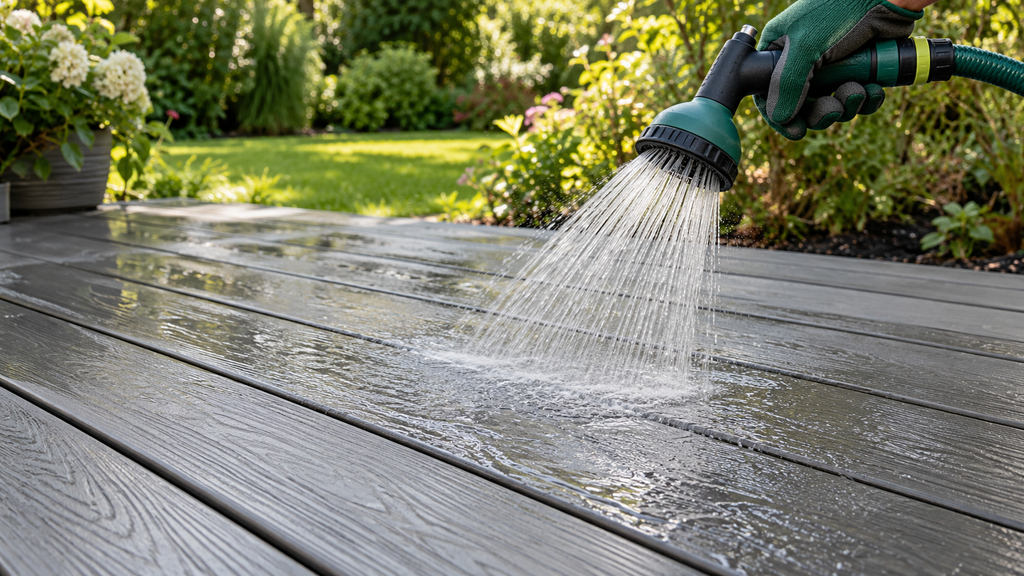
Use the rinse method specified for the product. A garden hose may be sufficient for routine work.
6. Allow the Deck to Dry Before Assessing It
Wet boards often look darker and more uniform than dry ones.
Wait until the surface has dried before deciding whether a stain remains. Check from more than one angle, especially where sunlight catches the grain.
If one mark persists whilst the surrounding dirt has gone, treat it as a separate problem. Repeatedly scrubbing the whole deck can create unnecessary wear without addressing the cause.
Can You Pressure Wash Composite Decking?
Sometimes, but permission must come from the care instructions for the particular product.
There is no universal pressure setting that is safe for every composite deck.
Some manufacturers permit controlled pressure washing on certain ranges whilst advising against it on others. The pressure at the machine is also only one factor: nozzle type, distance, angle and time spent on one spot affect the result.
Before using a pressure washer, confirm:
- Whether it is permitted for the exact board range.
- The stated pressure limit.
- The required nozzle and working distance.
- Any restrictions around edges, joints and damaged areas.
- Whether pressure-related damage affects warranty cover.
Where pressure washing is allowed, treat the manufacturer’s limit as a maximum restriction, not a target to reach. Avoid concentrated or rotary jets unless explicitly approved.
If the product instructions cannot be established, arrange an assessment rather than experimenting. Our deck cleaning services cover wood and composite decking, with the cleaning approach selected for the surface.
Removing Common Marks Without Making Them Worse
A general wash will not necessarily remove every stain. Identify what caused the mark before choosing the next treatment.
| Problem | Appropriate starting point | What to avoid |
|---|---|---|
| Ordinary dirt or muddy footprints | Approved routine wash and thorough rinse | Abrasive scouring |
| Grease or food spills | Prompt removal using the specified cleaning method | Leaving oil to sit or applying an unapproved solvent |
| Leaf-shaped brown marks | Remove debris, wash, then check approved stain guidance | Assuming bleach is suitable |
| Green surface growth | Clean accumulated dirt and use a compatible treatment if required | Treating all green marks with the same chemical |
| Rust beneath furniture | Remove the source and seek product-specific stain advice | General-purpose acid cleaners without approval |
| Pale marks after washing | Check for residue or water deposits | Repeatedly increasing detergent strength |
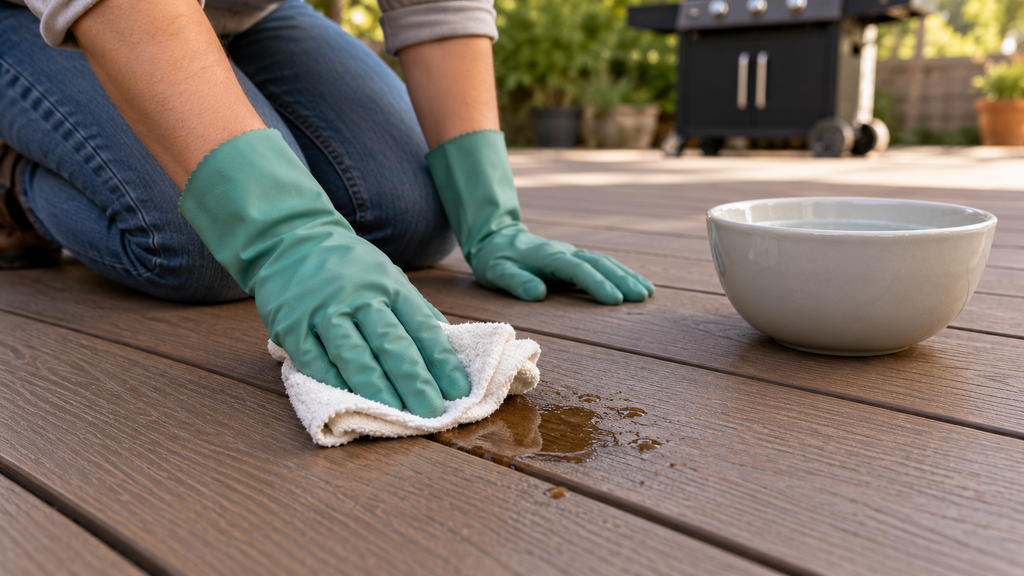
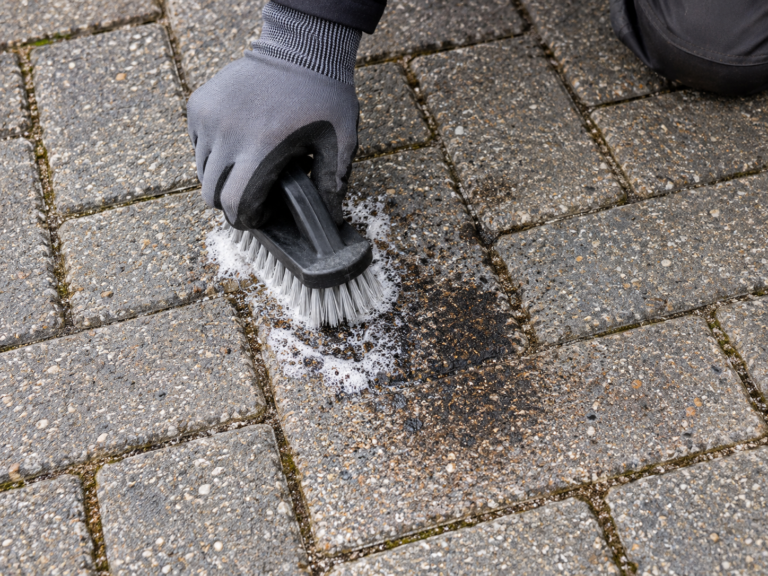
Grease, Oil and Barbecue Spills
Act promptly when food or grease lands on the decking.
Lift solid material carefully and blot liquid without spreading it across a larger area. Follow with the cleaning method approved for the boards.
Check warranty care requirements too. Some products set specific conditions for dealing with food and oil staining.
Do not assume that a solvent which removes grease from metal or paving is compatible with a composite surface.
Leaves and Brown Discolouration
Leaves left against damp boards can produce localised marks.
Remove the debris, carry out a routine clean and inspect the area after drying. Some older wood-containing products can also show tannin-related discolouration.
These marks may need a product-specific approach. A cleaner suitable for an older uncapped board may be inappropriate for a newer capped surface.
Green Algae and Slippery Deposits
Composite decking can still collect dirt and support surface growth.
Pay particular attention to shaded areas beneath trees, around planters and in corners where debris accumulates. Clean the surface using the approved method and check whether an additional compatible treatment is needed.
Restrict use of slippery areas until they have been addressed. Cleaning may improve the surface, but persistent wetness or pooling deserves a separate inspection.
Rust and Construction Residue
Rust from furniture or metal debris needs different consideration from organic staining.
Likewise, cement, mortar and construction dust should not be treated as ordinary garden dirt. Tell the decking manufacturer or cleaning contractor what reached the surface and how long it has been there.
Avoid sanding, scraping or applying a strong chemical before checking the recommended treatment.
Can You Use Washing-Up Liquid on Composite Decking?
A mild detergent may be permitted for some products, but it is not a universal recommendation.
Check the care guide and use the stated dilution. More detergent can create more rinsing work and leave a film if it dries on the surface.
If the manufacturer specifies its own cleaner or a particular compatible product, follow that guidance.
Avoid mixing products or adding another cleaner to an existing solution.
Is Bleach Safe for Composite Decking?
Do not use household bleach as a default treatment.
Compatibility depends on the board construction, finish and manufacturer’s instructions. An unsuitable product can alter the colour or appearance.
The same caution applies to acid cleaners, solvents and products intended for timber or masonry. “Outdoor cleaner” does not mean “safe for every outdoor surface”.
Use a chemical treatment only when it is approved for the decking and appropriate to the stain.
Should You Sand Composite Decking to Remove a Stain?
Sanding should not be a routine stain-removal method.
It can change the texture and appearance of the board and may damage a protective cap. The affected patch can remain visible even if the original stain becomes lighter.
Do not treat composite like a timber deck that can simply be sanded and refinished.
For scratches, burns or stubborn marks, ask the manufacturer whether there is an approved repair method. Some damage may require replacement of the affected board.
Why Does Decking Look Patchy After Cleaning?
Several issues can produce an uneven finish:
- Dirt remains in parts of the surface texture.
- Cleaner or dirty rinse water has dried on the boards.
- Shaded areas are still damp.
- Weathering differs beneath furniture and exposed areas.
- A stain or damaged finish remains after the general dirt has gone.
Begin by letting the surface dry fully.
If residue is suspected, check the recommended rinsing procedure. If a patch has a noticeably different sheen or texture, stop further scrubbing and seek advice.
A patchy appearance is a reason to reassess the surface, rather than automatically repeat the clean at higher pressure.
How Often Does Composite Decking Need Cleaning?
Use the manufacturer’s maintenance schedule as the starting point, then adjust for the conditions around the deck.
A surface beneath trees may collect debris faster than an open terrace. A barbecue area may need prompt spot cleaning between general washes.
Inspect after heavy leaf fall and deal with spills when they happen. Regular removal of loose debris can reduce the amount of intensive cleaning needed later.
Low maintenance still involves routine care.
Keep Adjacent Paving Treatments Off the Boards
Decking often sits beside a patio, steps or a paved path, and the surfaces may need different cleaning products.
Do not allow a treatment intended for paving to run across composite boards without checking compatibility. The same applies to overspray from nearby work.
If both areas need attention, plan the cleaning sequence and protection together. Our patio cleaning services explain the related service for neighbouring hard surfaces.
When Professional Cleaning Is Worth Considering
Arrange an assessment if the decking product is unknown, staining is widespread or previous cleaning has left visible marks.
Share the board brand and range if available, along with photographs of the whole deck and close-ups of affected areas. Mention any cleaners or pressure washing already used.
For properties in Twickenham, Richmond, Teddington and surrounding areas, ask for a quotation that explains the proposed method, stain-treatment scope and expected limitations.
A useful cleaning plan should distinguish removable dirt from weathering, discolouration and physical damage.
Frequently Asked Questions
What is the safest way to clean composite decking?
Identify the exact product and follow its care guide. For routine work, this commonly involves removing debris, using an approved cleaner and brush, and rinsing thoroughly. Equipment and product requirements vary.
Can I clean composite decking with a garden hose?
Often, a hose is suitable for rinsing routine dirt and cleaning solution. It may not remove established deposits without the approved washing and brushing process.
Can I use a stiff brush?
Only if it is suitable for the particular board. Some manufacturers specify softer brushes for composite ranges because abrasive brushing can dull the finish.
Does composite decking need sealing after cleaning?
Do not apply a sealer automatically. Many products do not require one, and an incompatible coating can alter the surface. Check the manufacturer’s guidance.
Can I use a steam cleaner?
Only where the decking manufacturer expressly permits it. Do not assume that heat is a harmless alternative to pressure or chemicals.
Why is my composite decking still slippery?
Remaining contamination, persistent moisture or another surface condition may be involved. Inspect the area after cleaning and drying; repeated pooling may need assessment beyond cleaning.
Will cleaning remove scratches?
Cleaning removes contamination, but it does not necessarily repair scratches. Avoid abrasive attempts to blend them out unless the manufacturer provides a specific procedure.
Can pressure washing affect the warranty?
It can, particularly where the method is prohibited or damage results from exceeding the product’s instructions. Check the warranty and care guide before work begins.