
Gutters above conservatories and extensions can often be cleaned from ground level using a professional gutter vacuum with long suction poles and suitable attachments. Where the roof layout prevents safe access, a different approach may be needed, such as a properly selected access platform or scaffolding. For homeowners arranging exterior maintenance with Thames Face Clean, the first step is to assess the gutter’s position, the space around the property and the condition of the surfaces below it.
A conservatory can make an otherwise straightforward gutter clean more complicated. The gutter may be visible from the garden but positioned several metres beyond a safe standing point. A rear extension can create a similar problem, leaving the original roofline above a lower roof that blocks access.
The solution depends on more than height. The depth of the extension, the angle of the roof, the available working space and the type of blockage all affect how the job should be carried out.
This guide explains the available methods, what a thorough clean should include, and what to ask before booking.
Can Gutters Be Cleaned Without Standing on a Conservatory Roof?
Yes, in many cases. Professional gutter vacuum equipment can reach gutters above conservatories, porches and extensions while the operator remains on the ground. However, whether this is practical depends on the particular building and the equipment being used.
The key is having a workable route from the operator’s position to the gutter. A long pole is only useful if the cleaning attachment can enter the gutter and move along it with sufficient control.
For example, a relatively low gutter behind a deep conservatory may be more difficult to reach than a higher gutter beside an open driveway.
Where ground-based equipment cannot provide suitable access, the cleaner should explain the limitation and recommend an alternative. Walking across a conservatory roof should never be treated as the obvious next step.

Why Are Gutters Above Conservatories Difficult to Clean?
The main challenge is the obstruction beneath the gutter.
On a typical wall without an extension, there may be space directly below the roofline. Once a conservatory or extension has been added, that space disappears.
Several factors can make cleaning more complicated:
- Horizontal distance: The main house gutter may sit well behind the outer edge of the conservatory.
- Fragile roofing: Glass, polycarbonate panels and rooflights require particular care.
- Restricted visibility: The gutter channel may be hidden behind the roof edge.
- Limited side access: Narrow passages, fences and neighbouring buildings can restrict working positions.
- Roof projections: Overhanging tiles and awkward angles may prevent a cleaning attachment from entering the gutter.
- Compacted debris: Dense roots, established vegetation and solid obstructions may require direct access.
This is why a useful assessment considers the whole layout rather than simply asking how many storeys the property has.
Which Gutters Need Cleaning?
A conservatory or extension can create several separate drainage areas, and they should not be confused.
The original house gutter above the extension
This is usually the difficult-to-reach section. It collects rainwater from the main roof and may be positioned above the conservatory roof.
When it overflows, water can fall onto the glazing below, causing persistent splashing, dirty streaks and concentrated runoff.
The conservatory’s own gutters
These are fitted around the lower conservatory roof. Although they are usually lower, corners and narrow channels can still collect leaves, moss and sediment.
Cleaning the main house gutter does not automatically mean the conservatory gutters have also been cleared.
Extension gutters, outlets and roof drainage
An extension may have conventional gutters, a flat-roof outlet, a hopper or a concealed channel. Each arrangement needs an appropriate inspection.
A quotation should identify which drainage components are included so that one blocked section is not left untreated.
How Does a Gutter Vacuum Work Above a Conservatory?
A gutter vacuum draws debris out of the gutter through a cleaning attachment and a series of hollow suction poles. The material travels through the system into a collection container.
Suitable pole sections and attachments allow an operator to work above some obstacles without placing a ladder directly beneath the gutter.
The process can remove loose leaves, moss, wet sediment and other debris that the equipment can safely collect. A camera attached near the working end can help the operator inspect the channel and guide the cleaning.
However, a gutter vacuum is not suitable for every situation.
What affects whether vacuum cleaning is possible?
The cleaner needs to consider:
- The gutter’s height and distance from the available standing position.
- The conservatory’s depth and roof pitch.
- The clearance between the gutter and overhanging roof tiles.
- The space available to assemble and manoeuvre the poles.
- The condition and stability of the gutter.
- The type and amount of debris.
- Weather conditions and nearby hazards, including overhead cables.
A system’s advertised vertical reach should not be taken as a guarantee that it can reach the same distance across an extension. The actual working arrangement matters.
Can a vacuum remove every blockage?
No. Loose debris and wet build-up are different from firmly rooted vegetation, building materials or an obstruction lodged inside a downpipe bend.
Gutter guards can also prevent the cleaning attachment from reaching the debris beneath them.
If an obstruction cannot be removed safely from the ground, the job may need a different access method or a separate repair visit.
What Happens During a Professional Clean?
A thorough service should establish what is blocked, remove accessible debris and check the result. The precise process will depend on access and the condition of the drainage system.
1. Assess the property and access
Before starting, the cleaner should review the roof layout, ground conditions and any obstacles.
For gutters above a conservatory, useful questions include:
- Is there enough space to work from the garden or side passage?
- Can the gutter be reached without resting equipment on the conservatory?
- Are there overhead cables or other obstructions?
- Are any gutter sections visibly loose or damaged?
- Does the extension roof contain rooflights?
- Will specialist access equipment be needed?
Clear photographs can help with an initial quotation, although some properties require an on-site assessment.
2. Inspect the gutter channel
Where practical, a camera inspection can reveal the location and extent of debris.
It may also show standing water, vegetation or visible defects that need further investigation. An inspection from one position may not show every section, so any limits should be explained.
3. Remove the debris
The cleaner uses the selected method to clear accessible material, working along the gutter rather than concentrating only on the most obvious pile of leaves.
Where vacuum cleaning is suitable, the collected debris is drawn into the machine instead of being deliberately washed onto the roof below.
4. Check outlets and downpipes
A clear gutter can still overflow if water cannot leave through its outlet.
Accessible outlets should therefore be checked as part of the agreed work. Downpipes may need additional investigation if there are signs of a blockage further down.
Clearing the visible channel alone does not prove that the entire drainage route is unobstructed.
5. Review the result
After cleaning, a further inspection helps show what has been removed and whether any problem remains.
Where appropriate and practical, a controlled water check may help assess drainage. Water should not simply be added to a system that is already known to be blocked.
For the scope of routine clearance and drainage checks, see our professional gutter cleaning services.
What If Ground-Level Cleaning Is Not Possible?
Some properties need direct access because the gutter is too far back, the cleaning angle is unsuitable or the obstruction cannot be removed by suction.
The access method should be selected for the actual site.
| Access method | When it may be considered | Main limitation |
|---|---|---|
| Gutter vacuum and suction poles | The gutter can be reached and worked on from a suitable ground position | Roof geometry or solid obstructions may prevent effective cleaning |
| Suitable access tower | There is space for a correctly erected tower in a useful position | A tower beside an extension may still leave the gutter out of reach |
| Mobile elevating work platform | Direct access is needed and the site can accommodate the equipment | Access width, ground conditions and working reach must be assessed |
| Professionally designed scaffolding | The layout is particularly awkward or repairs are also required | Additional planning, installation time and cost |
A ladder may be appropriate for some accessible sections following an assessment. It does not solve the problem of a gutter positioned beyond a conservatory roof, and leaning across the roof introduces additional risks.
The contractor should be able to explain how the proposed equipment provides a safe working position.
Can Someone Walk on the Conservatory or Extension Roof?
A conservatory roof should not be assumed to support a person’s weight. Glass and polycarbonate panels, glazing bars and decorative roof elements are not substitutes for a properly planned working platform.
A solid-looking extension roof also needs assessment. Rooflights, deteriorated materials and unprotected edges can create hazards that are not obvious from the garden.
For homeowners, the practical point is simple: do not climb onto the roof to reach the gutter, and do not accept an improvised access arrangement.
If direct access is necessary, it should be planned by a competent contractor using suitable equipment.
Why Might Gutters Still Overflow After Cleaning?
Overflow does not always mean that leaves were missed.
Cleaning removes debris; it does not correct every drainage or roofline defect.
Possible causes of continued overflow include:
A blocked downpipe
An obstruction may be lodged below the outlet or inside a bend. The gutter can look clear while water still has nowhere to go.
Incorrect gutter alignment
A sagging section or unsuitable fall can allow water to collect away from the outlet.
Leaking joints
A failed joint or seal may drip even when water is moving through the gutter normally.
Loose or damaged brackets
Poorly supported guttering can move, sag or pull away from the fascia.
Water overshooting the gutter
Rainwater may pass over the edge rather than enter the channel. Roof details, gutter position and concentrated runoff can contribute.
A problem with the extension roof
A leak around flashing, a roof junction or a conservatory seal may resemble a gutter problem.
If water continues to enter the building after clearance, further investigation may be needed from a suitable roofing or drainage specialist.
Signs That Hard-to-Reach Gutters Need Attention
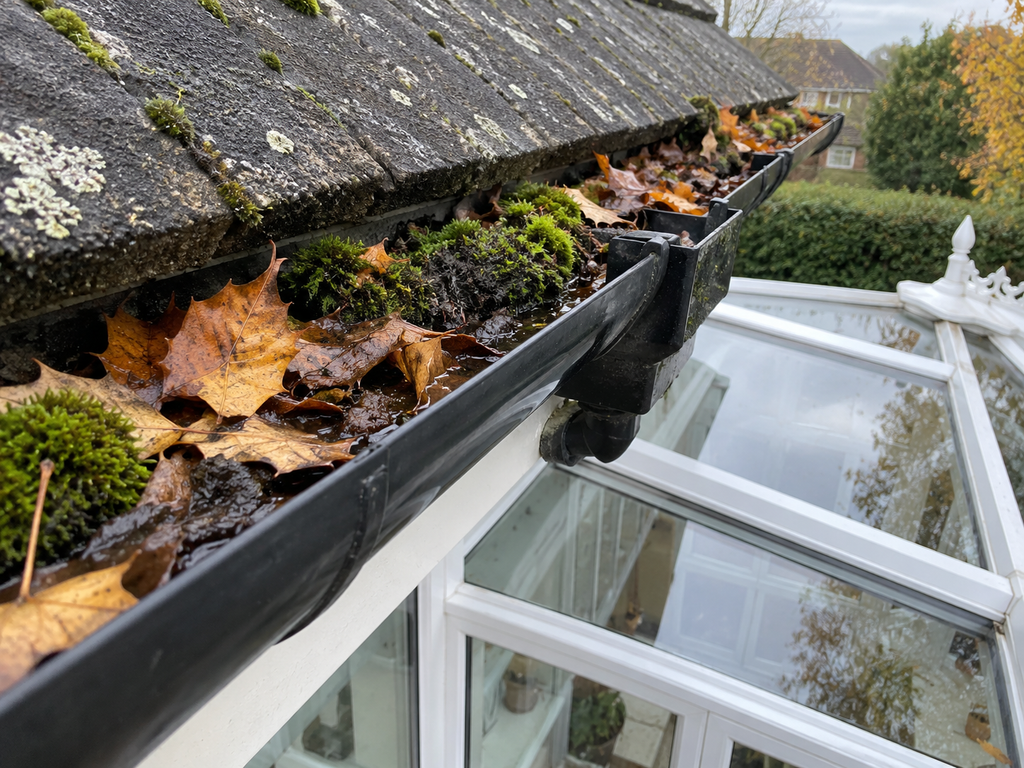
You do not need to see inside the channel to notice a possible problem.
Look for:
- Water spilling over the gutter edge during ordinary rainfall.
- Repeated splashing onto the same area of conservatory glazing.
- Plants growing from the gutter.
- Dirty streaks beneath joints or outlets.
- Visible sagging.
- Debris collecting around a downpipe opening.
- Persistent damp patches near the affected roofline.
These signs indicate that an inspection is worthwhile, but they do not identify the cause on their own.
Observing the area from a safe indoor position during rainfall can help you describe the problem. There is no need to climb a ladder to take photographs.
Is Gutter Cleaning the Same as Conservatory Roof Cleaning?
No. They address different parts of the property.
Gutter clearance removes material from the rainwater channel and helps restore drainage.
Conservatory roof cleaning removes surface dirt and organic build-up from roof panels, glazing and other agreed components.
A conservatory roof can look clean while the gutter above it remains blocked. Equally, a cleared gutter will not remove existing staining from the glass below.
If both areas need attention, ask for them to be assessed together. Our conservatory cleaning services cover the separate task of cleaning the conservatory’s exterior surfaces.
Should Roof Moss Be Addressed Too?
If substantial moss is regularly falling from the main roof, clearing the gutter may only deal with the immediate accumulation.
That does not mean every property needs a full roof clean. The condition of the roof, the amount of moss and how quickly debris returns should guide the decision.
Where wider maintenance is appropriate, roof cleaning services can be considered alongside gutter clearance. The method should suit the roof material and its condition.
Gutters should also be checked after roof work or moss removal, as loosened material can collect in the channels and outlets.
How Often Should These Gutters Be Cleaned?
There is no single schedule that suits every property.
Spring and late autumn are useful inspection points, but the need for cleaning depends on how quickly debris accumulates.
More frequent checks may be worthwhile where:
- Trees overhang the roof.
- Moss regularly falls into the gutter.
- Previous blockages have caused overflow.
- The drainage arrangement has several corners or outlets.
- Nearby building work has introduced debris.
- The gutter is difficult to observe from the ground.
After the first clean, ask what was found. A channel filled with seasonal leaves may need a different maintenance plan from one that was mostly clear but had a single blocked outlet.
Do not wait for the next scheduled visit if water is already entering the property or repeatedly overflowing.

How Much Does Gutter Cleaning Above a Conservatory Cost?
The price depends on the work and access required. The presence of a conservatory alone does not determine the cost.
A gutter that can be reached from the garden may require a different quotation from one that needs a hired access platform or scaffolding.
The main factors include:
- The length and height of the guttering.
- The depth and position of the conservatory or extension.
- Available rear and side access.
- The severity and type of blockage.
- Whether downpipes need additional attention.
- Whether gutter guards need to be removed.
- Any specialist access equipment.
- Whether separate cleaning or repair work is requested.
Before booking, ask whether the quotation includes inspection, debris removal, outlet checks, waste collection and any available completion photographs.
Also clarify what happens if the gutter cannot be reached using the initially proposed method. Additional work and access costs should be discussed before proceeding.
How to Prepare for the Visit
A little information in advance can help the contractor plan the job.
Send useful photographs
Where possible, provide:
- A wide photograph showing the house and the whole conservatory or extension.
- A photograph from each accessible side.
- A ground-level view of the affected gutter.
- Images of any visible overflow, staining or damage.
- A photograph showing the garden or passage where equipment could be positioned.
Include your postcode and explain when the problem occurs.
Make access available
Move lightweight furniture and other portable obstacles from the agreed working area. Let the contractor know about locked gates, narrow passages and anything that may restrict equipment access.
Ask beforehand whether electricity or water is required.
Mention previous problems
Tell the cleaner about known leaks, loose guttering, damaged panels, previous repairs and recurring blockages.
This helps distinguish routine clearance from an issue that may need specialist investigation.
Questions to Ask Before Booking
A clear explanation of the method is more useful than a blanket promise that every gutter can be reached.
Ask:
- How will you access the section above the conservatory?
- Can the work be completed from the ground?
- What will happen if the initial method cannot reach the blockage?
- Are the conservatory’s own gutters included?
- Will outlets and accessible downpipes be checked?
- Can you provide before-and-after images?
- Are repairs included or quoted separately?
- Does your insurance cover the proposed work?
- Are there any additional access charges?
These questions help establish what you are paying for and what a successful visit should achieve.
Frequently Asked Questions
Can gutters above a conservatory be cleaned without a ladder?
Often, yes. A suitable gutter vacuum and suction-pole arrangement may allow cleaning from the ground. The building layout, available working space and type of blockage determine whether this is practical.
Can cleaners reach over a wide extension?
Sometimes, but the extension’s depth and the gutter’s position must be assessed. Equipment that can reach a high gutter beside an open wall may not provide the same access across a wide roof.
Will gutter cleaning damage the conservatory roof?
The method should be planned to protect the structure below. Equipment should not be rested on glazing or used in a way that puts pressure on roof panels. Existing damage should be identified before work begins.
Can a gutter vacuum remove plants?
It may remove loose vegetation and debris. Established roots or material trapped around brackets and joints may require direct access. Pulling forcefully on vegetation can also damage weakened guttering.
Does gutter cleaning include unblocking every downpipe?
The agreed scope should make this clear. Checking an accessible outlet is different from locating and clearing an obstruction deep inside a downpipe or underground drain.
Do gutter guards prevent the need for cleaning?
Not completely. Fine debris can build up beneath some guards, and leaves can collect on top. Certain systems also need to be removed before the gutter can be cleared properly.
Can the work be done in bad weather?
It depends on the conditions and the method. Strong wind, lightning, ice or poor visibility can make work unsuitable. The contractor should decide whether the job can proceed safely.
Do I need to be at home?
This depends on the access arrangements and the contractor’s requirements. If the rear garden is accessible and any required utilities have been arranged, it may be possible to complete the work while you are out. Confirm this when booking.
What if the gutter still leaks afterwards?
A remaining leak may involve a joint, bracket, gutter alignment, downpipe or roof detail. Ask what the post-clean inspection showed and whether a separate repair assessment is needed.
Arrange an Assessment for Your Hard-to-Reach Gutters
A conservatory or extension does not necessarily prevent gutter cleaning. It does mean the access method needs to suit the building.
Thames Face Clean provides exterior cleaning across West and South West London, including Twickenham, Richmond, Teddington, Hampton and Kingston.
To enquire about a difficult-to-reach gutter, send your postcode and a few clear photographs showing the roofline, the conservatory or extension, and the available access. Explain whether you have noticed overflow, visible debris or a recurring leak.
An initial assessment can help establish the likely approach, the work required and whether a closer inspection is needed before a quotation can be confirmed.