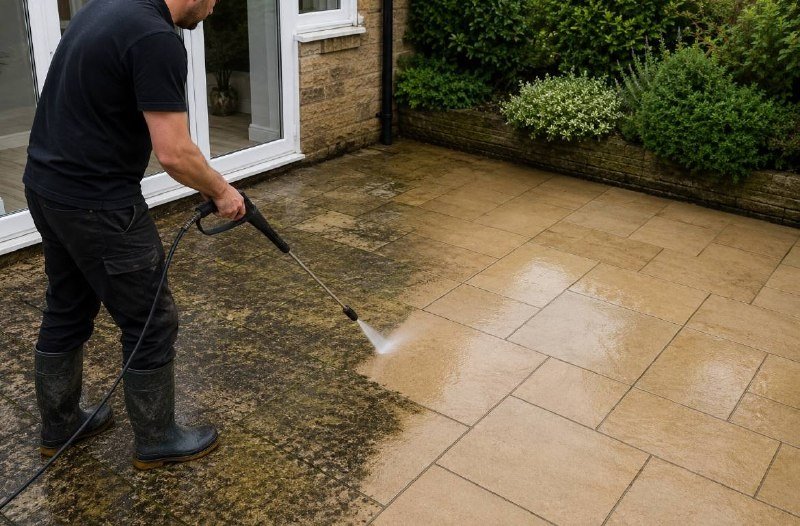
Black spots on a patio can make an otherwise well-maintained garden look dirty, neglected and much older than it really is. If you have noticed small black or dark patches appearing across your paving, you may be wondering how to remove black spots from patio surfaces effectively — and, more importantly, how to stop them from coming back.
In most cases, these stubborn black marks are associated with lichen and other organic growth that develops on outdoor paving. Unlike ordinary dirt, black spot lichen can become firmly attached to porous materials such as sandstone, limestone, concrete and block paving. This is one reason why simply using a pressure washer does not always produce the results homeowners expect.
The good news is that black spots can often be significantly reduced or removed with the right cleaning approach. The key is to identify the cause, choose a method suitable for the paving material and address the conditions that encourage organic growth.
In this guide, we explain what causes black spots on patios, how to remove them, why pressure washing sometimes fails, and how to prevent them from returning.
What Causes Black Spots on a Patio?
The first step in learning how to remove black spots from patio surfaces is understanding what you are actually dealing with.
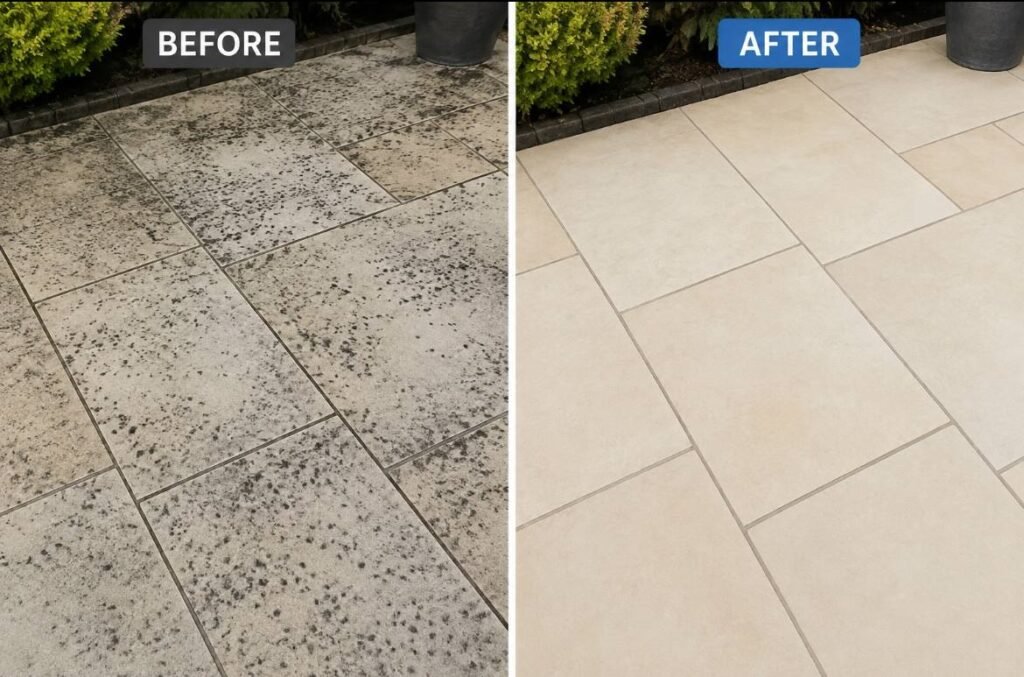
Although black marks can sometimes be caused by dirt, pollution or staining, persistent small black spots on outdoor paving are commonly associated with lichen. Lichen is a biological growth involving fungi and photosynthetic organisms, and it can establish itself on hard outdoor surfaces.
Lichen and other organic growths are particularly common on patios because outdoor paving is exposed to:
- Rain and moisture
- Shade
- Poor air circulation
- Falling leaves and organic debris
- Soil and garden waste
- Seasonal changes in temperature
- Persistent dampness
- Poor drainage
The Royal Horticultural Society notes that algae, lichens, mosses and related growths are common on hard surfaces and tend to thrive in moist environments. Growth can be particularly noticeable in shaded areas with poor air circulation.
Why Are the Black Spots So Difficult to Remove?
One of the biggest problems with patio black spots is that they are not necessarily just sitting on top of the paving.
Lichen can attach strongly to porous surfaces and become established within tiny imperfections and pores. This is particularly noticeable on natural stone paving.
As a result, you may pressure wash a patio and remove:
- Surface dirt
- Mud
- Loose moss
- Green algae
- General grime
while some of the black spotting remains.
This is why homeowners sometimes feel frustrated after spending hours cleaning their patio only to find that the black spots are still visible.
Are Black Spots on a Patio Dirt, Mould or Lichen?
It is not always possible to identify the cause simply by looking at a photograph, but the appearance can provide some clues.
Black Lichen
Small, dark, firmly attached spots that remain after ordinary cleaning are often associated with lichen. These can be particularly stubborn on natural stone and older paving.
Algae
Algae commonly produces a green, dark green or slippery film. It is especially common in damp and shaded locations.
Moss
Moss is generally easier to identify because it forms a visible green growth, particularly in joints and cracks between paving slabs.
General Dirt and Staining
Patios can also develop dark marks from soil, leaves, food, drink, pollution and other organic debris.
This distinction matters because different types of contamination may require different cleaning methods.
How to Remove Black Spots from Patio Surfaces
If you want to remove black spots from patio paving, there is no single method that is suitable for every patio.
The correct approach depends on:
- The type of paving
- How severe the staining is
- Whether the spots are biological growth
- The condition of the surface
- The condition of the joints
- Drainage around the patio
- The amount of shade the patio receives
A professional cleaner should assess the surface before choosing the cleaning method.
Method 1: Sweep and Brush the Patio
Before using water or cleaning treatments, remove loose dirt, leaves and debris.
Use a stiff outdoor broom to remove:
- Leaves
- Soil
- Loose moss
- Twigs
- Organic debris
For moss growing between slabs, a suitable joint brush or hand tool can help remove the visible growth.
Regular brushing is also useful as a preventative measure because it reduces the amount of organic material available for algae, moss and other growths to establish. The RHS recommends regular brushing and manual removal as practical ways of controlling growth on hard surfaces.
However, brushing alone is unlikely to completely remove established black spot lichen.
Method 2: Use a Suitable Patio Cleaning Treatment
For stubborn organic growth, a suitable patio cleaning treatment may be more effective than water alone.
The important point is to choose a product that is appropriate for the specific paving material.
Natural stone such as sandstone and limestone can be sensitive to unsuitable cleaning products. Before applying any chemical treatment, always check the manufacturer’s guidance and follow the product’s instructions.
Avoid randomly combining cleaning chemicals. Some products can damage paving, surrounding vegetation, metalwork or jointing materials if used incorrectly.
A professional patio cleaning company can assess the surface and determine whether a treatment is appropriate.
Method 3: Pressure Washing
Pressure washing can be highly effective for removing surface dirt, algae, moss and general grime.
However, pressure washing alone is not always the best answer for black spots.
The RHS confirms that pressure washing can remove established growths, but also warns that it should be used carefully, particularly where drainage is poor. It can also be a temporary solution if the underlying conditions that encourage growth remain unchanged.
Using excessive pressure can also create problems.
Depending on the paving material, aggressive pressure washing may:
- Damage delicate natural stone
- Remove or disturb jointing material
- Create uneven cleaning patterns
- Roughen the surface
- Cause water to enter unwanted areas
For this reason, the pressure should be adjusted according to the surface rather than simply using the highest possible setting.
Why Pressure Washing Doesn’t Always Remove Black Spots
This is one of the most common questions homeowners ask.
Why are black spots still visible after pressure washing?
The answer is that pressure washing primarily works mechanically. It uses water pressure to remove contamination from the surface.
Black lichen can be much more stubborn because it can become firmly attached to the paving.
A pressure washer may therefore make the patio look considerably cleaner while leaving some dark spots behind.
Increasing the pressure is not necessarily the solution.
In fact, repeatedly increasing pressure to try to remove every black spot can potentially cause unnecessary damage to the paving.
A better strategy can involve combining appropriate treatment, controlled cleaning and careful rinsing rather than relying on maximum water pressure.
Step-by-Step Professional Approach to Patio Black Spot Removal
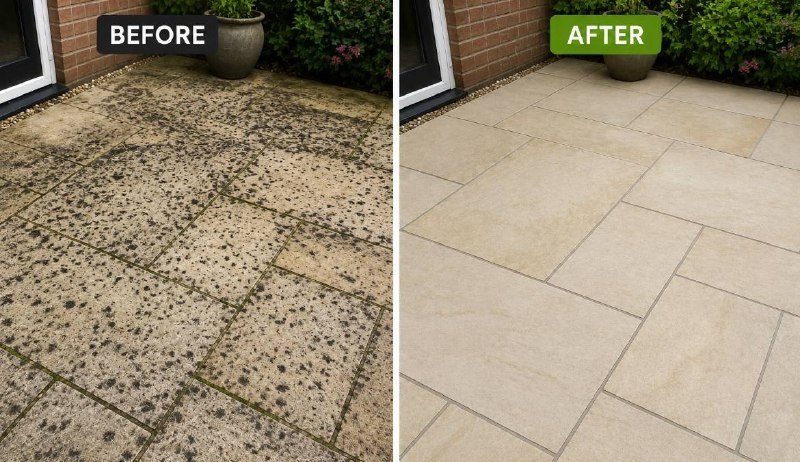
For a heavily affected patio, a professional cleaning process may involve several stages.
1. Inspect the Patio
The paving material should be identified before cleaning begins.
Common patio materials include:
- Indian sandstone
- Limestone
- Concrete
- Block paving
- Porcelain
- Slate
- Other natural stone
Each material has different characteristics and cleaning requirements.
2. Remove Loose Debris
Leaves, dirt, moss and other loose contamination are removed before deeper cleaning.
3. Apply an Appropriate Treatment
Where biological growth is present, an appropriate treatment may be used to target algae, lichen or moss.
The treatment should be suitable for the surface and applied according to the manufacturer’s instructions.
4. Allow Appropriate Dwell Time
Some treatments need time to work before the surface is rinsed.
This is an important difference between simply spraying a patio with water and carrying out a properly planned cleaning process.
5. Agitate Stubborn Areas if Necessary
Some areas may require additional brushing or mechanical agitation.
6. Rinse and Clean the Surface
The patio can then be thoroughly rinsed and cleaned using an appropriate pressure level for the paving.
7. Inspect the Result
Once the surface has been cleaned, remaining staining can be assessed.
It is important to understand that severely weathered or deeply stained paving may not always return to its original appearance after one cleaning.
How to Prevent Black Spots from Coming Back
Removing black spots is only part of the solution.
If the patio remains damp, shaded and covered with organic debris, the conditions that encouraged the growth in the first place will still exist.
The RHS recommends several practical measures to discourage algae, moss and lichen, including improving drainage, reducing shade and increasing airflow.
1. Improve Drainage
Standing water creates a favourable environment for moisture-loving growth.
Check whether:
- Water collects on the patio
- Drains are blocked
- Nearby soil remains saturated
- Water runs towards the paving
- Downpipes discharge too close to the patio
Keeping drainage routes clear can help the surface dry more quickly.
2. Reduce Excessive Shade
Patios beneath trees, beside tall fences or close to buildings may receive very little sunlight.
Where practical, trimming overhanging vegetation can increase sunlight and airflow.
This can help the patio dry faster after rainfall.
3. Sweep the Patio Regularly
Leaves and organic debris should not be allowed to accumulate for long periods.
Regular sweeping removes material that can retain moisture and contribute to organic growth.
4. Keep Patio Joints Clear
Moss and weeds often begin growing in the joints between paving slabs.
Regular maintenance can prevent small areas of growth from becoming a larger problem.
5. Clean the Patio Periodically
You do not necessarily need to wait until your patio becomes heavily stained.
Regular maintenance cleaning can make it easier to control algae, moss and organic staining before they become established.
Can You Remove Black Spots from Every Type of Patio?
The answer depends on the paving material and the age and severity of the staining.
Indian Sandstone
Indian sandstone is porous and can develop stubborn organic staining. Cleaning needs to be carried out carefully to avoid damaging the surface.
Limestone
Limestone requires particular care because inappropriate cleaning products or techniques can damage the stone.
Concrete
Concrete paving is generally robust, but the correct pressure and cleaning method should still be selected according to its condition.
Block Paving
Block paving can accumulate moss, weeds and organic growth between individual blocks. Cleaning should take the joints into consideration.
Porcelain
Porcelain paving is relatively low-porosity, but dirt and biological growth can still accumulate on the surface and particularly around joints.
If you are unsure which cleaning method is suitable for your patio, professional assessment is usually safer than experimenting with aggressive chemicals or high-pressure equipment.
Common Mistakes When Removing Black Spots from Patios
Trying to remove black spots from patio surfaces yourself can sometimes create more problems than it solves.
Here are some common mistakes to avoid.
Using Too Much Pressure
More pressure does not always mean a better clean.
The correct pressure depends on the surface.
Using the Wrong Chemical
A cleaning product suitable for one material may be unsuitable for another.
Always check compatibility before applying any treatment.
Ignoring the Joints
Cleaning the surface while ignoring moss and organic growth between the slabs can make the patio look untidy again very quickly.
Cleaning Without Addressing Drainage
If water continually collects in the same areas, organic growth can return even after a thorough clean.
Expecting Instant Results
Some biological staining may require treatment and time rather than simply being blasted away immediately.
Cleaning Without Protecting Nearby Areas
Plants, lawns, walls, drains, furniture and other surfaces may need to be protected during professional cleaning.
When Should You Hire a Professional Patio Cleaning Service?
DIY cleaning can work well for light dirt and routine maintenance.
However, professional patio cleaning may be a better option when:
- Black spots cover a large part of the patio
- Pressure washing has already failed
- The paving is natural stone
- The patio is heavily shaded
- Moss and algae are widespread
- You are concerned about damaging the paving
- The surface has delicate or deteriorating joints
- You do not have the appropriate equipment
- You want a more thorough and consistent result
A professional cleaner can assess the surface before choosing the appropriate cleaning technique.
Professional Patio Cleaning in West and South West London
If your patio is covered in black spots, algae, moss or years of accumulated dirt, Thames Face Clean can help restore the appearance of your outdoor space.
Thames Face Clean provides professional exterior cleaning for homes and businesses across West and South West London, including Twickenham, Richmond, Teddington, Hampton, Kingston and East Sheen. The company offers patio cleaning using professional equipment and selects cleaning methods according to the surface being treated.
Rather than treating every patio in exactly the same way, the surface can be assessed first to determine the most suitable approach.
Looking for professional patio cleaning?
Don’t spend your weekend repeatedly pressure washing stubborn black spots.
Get in touch with Thames Face Clean for a free, no-obligation quotation and professional advice for your patio.
Whether you need to remove black spots, algae, moss, dirt or general staining, a properly assessed patio cleaning service can help bring your outdoor space back to life.
Request a Free Quote from Thames Face Clean
Frequently Asked Questions
What are the black spots on my patio?
Persistent black spots on outdoor paving are commonly associated with lichen and other biological growth. They are particularly common on porous paving and in damp, shaded locations.
Can I remove black spots from my patio with a pressure washer?
Pressure washing can remove surface dirt, algae and some organic growth, but it may not completely remove established black spot lichen. Using excessive pressure can also damage some paving materials.
Why do black spots keep coming back after patio cleaning?
Black spots can return when moisture, shade, poor airflow and organic debris continue to create favourable conditions for biological growth. Cleaning the surface without addressing these conditions may only provide a temporary improvement.
Does patio cleaning remove lichen?
A suitable professional cleaning process can significantly reduce or remove lichen and other organic growth. However, the result depends on the paving material, severity of growth, condition of the surface and cleaning method.
Is pressure washing safe for natural stone patios?
It can be, but the pressure and technique should be appropriate for the specific stone. Delicate natural stone should not automatically be treated with maximum pressure.
How often should I clean my patio?
There is no universal schedule because patios differ in location, material and exposure. A patio that is shaded and damp may require more frequent maintenance than a sunny, well-drained patio.
Can black spots permanently damage my patio?
Lichen and other organic growth primarily affect the appearance and cleanliness of the surface, but persistent growth can contribute to a neglected and slippery outdoor area. The RHS notes that algae, moss and similar growths can make hard surfaces slippery.
Should I use bleach to remove black spots from paving?
Do not assume bleach or another strong chemical is safe for your patio. Some cleaning chemicals can damage certain paving materials, plants or surrounding surfaces. Always check the manufacturer’s guidance or seek professional advice before using a chemical treatment.
Final Thoughts
Knowing how to remove black spots from patio surfaces starts with understanding that stubborn black marks are often more than ordinary dirt.
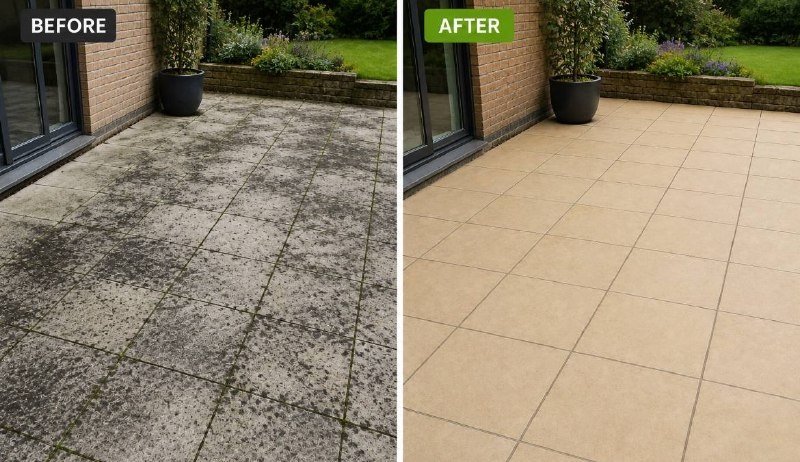
Lichen, algae, moss, moisture, shade and poor drainage can all contribute to the problem. While brushing and pressure washing can be useful, heavily established black spots may require a more carefully planned cleaning approach.
The most effective long-term strategy is not simply to clean the patio once. It is to remove existing organic growth, use an appropriate cleaning method for the paving material and reduce the damp, shaded conditions that encourage regrowth.
If your patio in West or South West London has stubborn black spots that refuse to disappear, Thames Face Clean can assess the surface and recommend an appropriate professional cleaning solution.
Ready to restore your patio? Get a free, no-obligation quote from Thames Face Clean today.
No responses yet