
Do Gutter Guards Really Prevent Blockages?
Gutter guards can reduce blockages caused by leaves and larger debris, but they cannot guarantee a blockage-free guttering system. Depending on the design, smaller particles may still enter the gutter, while wet leaves and moss can collect on top of the guard. Regular checks remain important, even after guards have been installed.
For homeowners, the useful question is not simply whether gutter guards work. It is whether a particular system suits the roof, surrounding trees and maintenance needs of the property.
At Thames Face Clean, we help homeowners maintain their properties with exterior cleaning services across West and South West London. This guide explains what gutter guards can realistically achieve, where they fall short and when professional gutter cleaning is still needed.
What Are Gutter Guards?
Gutter guards are protective covers, screens or inserts designed to reduce the amount of debris entering your gutters while allowing rainwater to drain through.
They are also described as gutter covers, leaf guards or gutter protection systems. However, these names cover several different designs, each with its own benefits and maintenance requirements.
Most systems aim to keep out some combination of:
- Fallen leaves.
- Twigs and larger plant material.
- Windblown debris.
- Some pieces of moss washed down from the roof.
They do not repair damaged guttering, correct an unsuitable gutter fall or clear an existing downpipe blockage.
A guard fitted over a poorly functioning gutter can leave the original problem hidden underneath.
How Do Gutter Guards Work?
Most gutter guards work in one of three ways:
- Screening: a mesh or perforated cover allows water through while holding larger debris above the gutter.
- Filtering through an insert: brush or foam products sit inside the gutter and create a barrier to some debris.
- Directing water around a cover: curved designs guide water towards an opening while encouraging larger debris to fall away.
Their effectiveness depends on more than the product itself. Installation, gutter condition, roof layout and the type of debris reaching the roofline all affect performance.
For example, a screen that handles broad leaves reasonably well may be less suitable where fine needles, seeds or roof sediment are the main concern.
Do Gutter Guards Really Stop Gutters Getting Blocked?
They can prevent some debris-related blockages, but they do not remove every possible cause of poor drainage.
A well-chosen, correctly fitted guard may reduce the volume of large leaves collecting inside the gutter. However, drainage can still be affected by:
- Debris covering the guard’s surface.
- Fine material passing through or around the guard.
- Material building up at the downpipe outlet.
- A blockage further down the downpipe.
- Sagging or incorrectly aligned guttering.
- Damaged joints or fittings.
- A system that cannot cope with the volume of water reaching it.
Reducing debris inside a gutter and maintaining reliable drainage are related tasks, but they are not the same thing.
If your gutters already overflow, start by identifying the cause. Installing a cover before investigating the problem may add cost without improving water flow.
Types of Gutter Guards: Benefits and Limitations
There is no single best gutter guard for every UK home. The following comparison outlines common designs and the issues worth checking before choosing one.
| Guard type | How it works | Potential benefit | Maintenance consideration |
|---|---|---|---|
| Mesh or perforated screen | Covers the gutter with openings for water | Can keep larger leaves out of the channel | Leaves can cover the surface; smaller debris may pass through |
| Fine mesh or micro-mesh | Uses smaller openings to filter debris | Can exclude finer material than a coarse screen | Fine deposits and surface debris can restrict the openings |
| Brush insert | Sits inside the gutter with projecting bristles | Can hold larger debris away from parts of the water channel | Leaves and needles can become caught between the bristles |
| Foam insert | Allows water through a porous insert | Can limit larger debris entering the space it occupies | Pores can become fouled; condition and replacement requirements vary |
| Curved or hooded cover | Directs water towards an opening beneath an edge | Can shed larger debris away from the gutter | Correct positioning and compatibility with roof runoff are important |
| Downpipe outlet guard | Screens the entrance to the downpipe | Can reduce larger debris entering the pipe | Debris can gather around the outlet and still require removal |
Performance varies between products within each category. Check the manufacturer’s installation instructions, maintenance requirements and warranty terms rather than relying on the design name alone.
Mesh and Fine-Mesh Guards
Mesh covers are intended to separate debris from rainwater before it enters the gutter.
The size of the openings matters. Larger openings may allow more small material through; finer openings filter smaller particles but can require attention when their surface becomes covered.
Also check how the guard is secured and whether sections can be removed for cleaning. A product that is difficult to access can make future maintenance more involved.
Brush Gutter Guards
Brush inserts sit within the gutter rather than forming a flat cover above it.
They can help reduce the movement of larger leaves towards outlets, but material can become trapped in the bristles. Cleaning may involve removing the inserts, clearing the gutter and cleaning the brushes before reinstalling them.
They should not be treated as a substitute for inspecting the channel underneath.
Foam Gutter Guards
Foam inserts allow water to move through a porous structure.
Before choosing this type, check how the product should be cleaned, how its condition is assessed and when replacement may be necessary. Debris collecting on top or within the insert can affect drainage.
Downpipe Leaf Guards
A downpipe leaf guard protects a specific outlet rather than the whole length of guttering.
This can be useful where larger debris repeatedly reaches the downpipe entrance. However, the retained material still needs somewhere to go. If it accumulates around the guard, water may struggle to reach the outlet.
Why Can Gutters Still Block With Guards Installed?
1. Wet Leaves Can Form a Layer Over the Guard
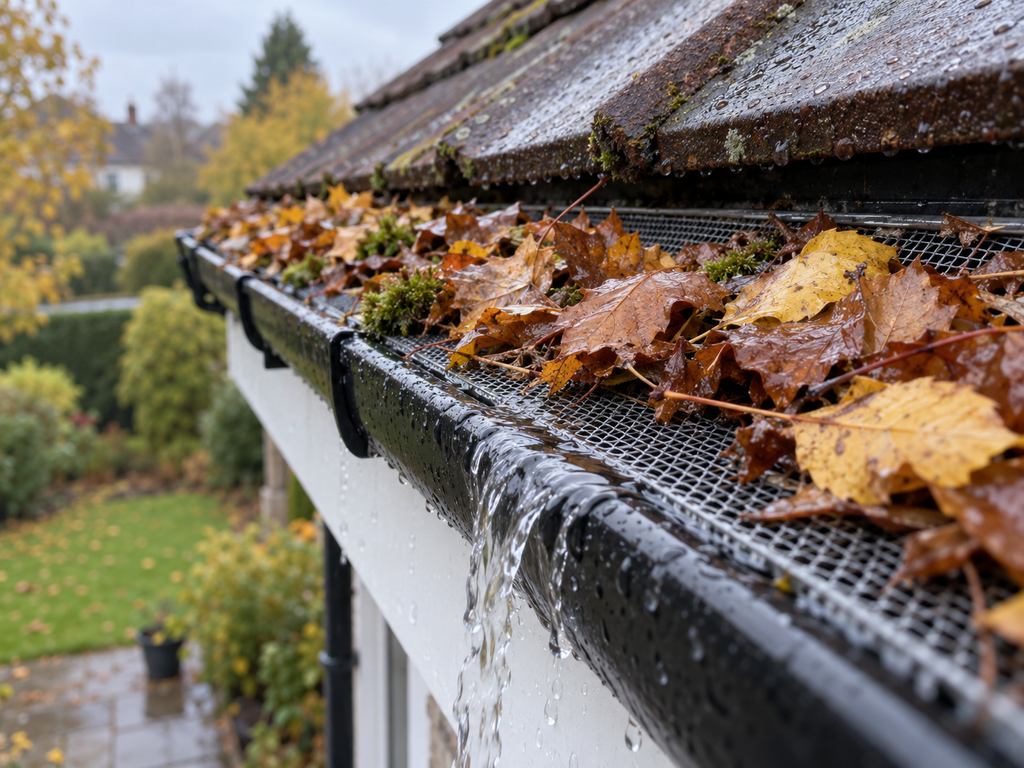
A cover may stop leaves entering the gutter but leave them sitting across its surface.
When wet leaves overlap, they can restrict the openings through which rainwater should pass. This is especially relevant where overhanging trees regularly drop material onto the roof.
The gutter underneath may appear relatively clear while water still spills over the edge.
2. Fine Debris Can Build Up Over Time
Depending on the design and fit, small seeds, fine organic material and roof sediment may enter through openings or gaps.
Small amounts may cause little immediate difficulty. Over time, however, deposits can collect in low spots or near outlets.
This is one reason a clean-looking guard does not always confirm that the gutter beneath it is clear.
3. Moss Can Collect on Top
Pieces of moss washed from a roof can lodge on mesh, become caught in brush inserts or collect around an outlet guard.
If the roof is repeatedly shedding substantial amounts of moss, gutter maintenance alone may not address the source of the debris.
Our roof cleaning services explain the available approach to roof cleaning. The suitability of any treatment should be assessed for the roof material and condition.
4. Gaps and Poor Fitting Can Let Debris Through
A guard that does not match the gutter profile may leave openings around corners, joints or fixings.
Loose or displaced sections can also change how water enters the gutter. Choosing the right size and fitting method is therefore as important as choosing the guard material.
5. The Downpipe May Already Be Blocked
A gutter cover cannot clear material that is already lodged further down the drainage route.
Rainwater may enter the gutter normally and then back up because it cannot discharge through the downpipe or the connected drainage system.
Cleaning only the guard’s visible surface will not resolve that problem.
6. The Problem May Be Gutter Condition or Capacity
Overflow is not always caused by leaves.
A sagging section can retain water. An unsuitable fall can prevent effective drainage. Concentrated runoff from a roof valley may overwhelm a particular section or outlet.
Guards do not correct these faults. Persistent overflow after cleaning calls for further investigation.
Do Gutter Guards Work in Heavy Rain?
They can, provided the product is suitable for the roof and guttering, correctly installed and adequately maintained.
However, heavy rain can expose weaknesses that are less noticeable during light showers. A debris-covered screen, an unsuitable installation angle or concentrated roof runoff may cause water to bypass the gutter opening.
If water spills over during rainfall, look at where it happens:
| What you notice | Possible explanation |
|---|---|
| Water flowing over a visibly leaf-covered guard | Surface debris may be restricting water entry |
| Overflow concentrated near a downpipe | The outlet, downpipe or downstream drainage may be restricted |
| Water collecting in one section | Gutter alignment or sagging may need attention |
| Dripping from a joint | A joint or seal may be defective |
| Overflow continuing after debris has been removed | Capacity, positioning or another drainage fault may need investigation |
These observations are clues rather than a diagnosis.
For a broader explanation of the causes, read our guide to why gutters overflow in heavy rain.
Are Gutter Guards Worth It for London Homes?
They may be worth considering where leaves repeatedly enter otherwise sound, correctly functioning guttering.
For homes in Twickenham, Richmond, Teddington and nearby areas, the important factors are the conditions around the individual property. A tree-lined garden, a moss-covered roof and a sheltered roof valley create different maintenance demands from an exposed roof with little surrounding vegetation.
Gutter Guards May Be Useful When:
- Large leaves are the main recurring cause of blockage.
- The gutters and downpipes are already in good working order.
- A compatible product can be fitted without compromising the roofline.
- The guards can be accessed and removed for maintenance.
- You understand the ongoing servicing requirements.
They May Offer Less Value When:
- Gutters repeatedly overflow because of alignment or capacity problems.
- Fine debris is the main issue and the chosen guard does not suit it.
- Heavy moss deposits are continually falling from the roof.
- Existing blockages have not been cleared.
- Installation makes routine cleaning significantly more difficult.
- The purchase depends on an assumption that future maintenance will disappear.
Before buying guards, establish what is causing the blockages and how the proposed product addresses that specific problem.
Gutter Guards vs Regular Gutter Cleaning
Gutter guards and gutter cleaning perform different roles.
Guards aim to reduce incoming debris. Cleaning removes accumulated material and helps restore drainage where debris is the cause of restriction.
| Consideration | Gutter guards | Regular gutter cleaning |
|---|---|---|
| Main purpose | Reduce certain debris entering or moving through the gutter | Remove debris already present |
| Existing blockage | Does not clear it | Can address accessible debris-related restrictions |
| Future maintenance | Still requires a product-specific plan | Requires repeat visits as debris accumulates |
| Access | Some systems need removal before cleaning | Depends on property height, layout and equipment |
| Repairs | Does not correct gutter defects | Cleaning may reveal defects, but repair is a separate task |
| Cost assessment | Include installation, servicing and possible replacement | Include the frequency and scope of cleaning needed |
For some homes, guards and periodic cleaning work well together. For others, straightforward routine cleaning may be the more practical option.
If your guttering is already blocked, our professional gutter cleaning services are a sensible starting point before deciding whether additional protection is worthwhile.
How Often Should Gutters With Guards Be Checked?
Follow the guard manufacturer’s instructions and adjust the schedule to the amount of debris your property receives.
As a practical starting point, consider checks in spring and after the main autumn leaf fall. Additional checks may be appropriate after storms, unusually heavy leaf fall or visible overflow.
This is an inspection schedule, not a claim that every guarded gutter needs cleaning twice a year. Some systems and locations need more attention than others.
Spring Checks
Look for:
- Seeds, blossom and windblown material.
- Moss or debris deposited over winter.
- Loose or displaced guard sections.
- Signs of leaking joints or standing water.
Autumn Checks
Pay particular attention to:
- Leaves covering mesh or screens.
- Material caught in brush inserts.
- Debris around outlets.
- Roof valleys directing leaves towards one section.
Where nearby trees shed leaves over several weeks, one early clean may not cover the full leaf-fall period.
After Heavy Rain or Strong Winds
From a safe position at ground level, look for new overflow, displaced sections and unusual water staining.
You do not need to climb to notice that water is spilling over the edge. Persistent symptoms should prompt an inspection using suitable access equipment.
Signs Your Guarded Gutters Need Attention
Arrange a check if you notice:
- Water spilling over the gutter edge.
- Plants growing through the guard or gutter.
- Visible mats of leaves or moss.
- Dripping that continues well after rainfall.
- Repeated staining beneath the roofline.
- Loose or distorted guard sections.
- A gutter section that appears to sag.
- Water collecting near the base of a downpipe.
These symptoms do not all have the same cause. For example, staining can have several explanations, and a leaking joint does not automatically mean the gutter is blocked.
The aim is to identify the fault before choosing the remedy.
Can You Clean Gutters Without Removing the Guards?
Sometimes. It depends on the guard design, how it is fixed and where the debris has accumulated.
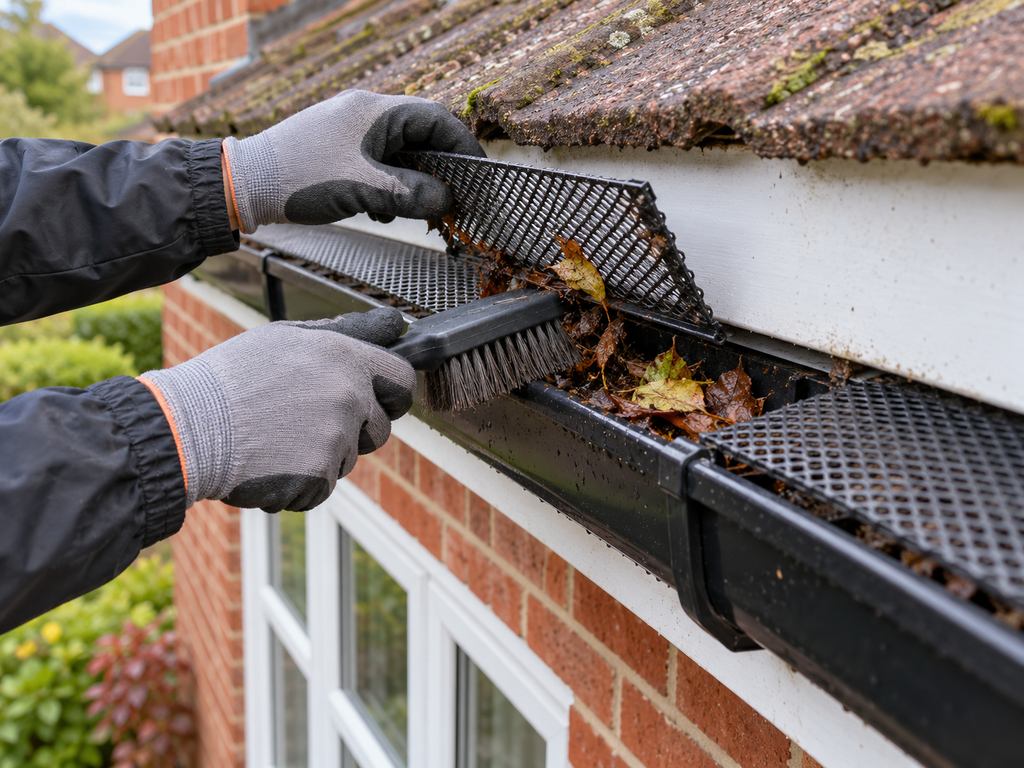
Loose material on top of a screen may be accessible without dismantling it. Debris underneath a fixed cover may require sections to be removed. Brush and foam inserts may need to be lifted out to clean the channel properly.
Before arranging a visit, tell the cleaning company:
- Which type of guard is installed.
- Whether it is clipped, screwed or otherwise secured.
- How high the gutters are.
- Whether a conservatory, extension or restricted side passage affects access.
- Where overflow or leakage occurs.
- Whether the product has servicing or warranty conditions.
A ground-based gutter vacuum cannot necessarily reach through every cover or remove every type of obstruction. The method must suit the installed system and the property.
Avoid forcing tools through a guard or using aggressive cleaning methods that could damage it. Follow the product instructions and use a professional where safe access is uncertain.
Should Gutters Be Cleaned Before Guards Are Installed?
Yes. Guards should be fitted to clean, functioning guttering rather than placed over existing debris.
Before installation, check that:
- The gutter channel has been cleared.
- Outlets and downpipes can drain.
- Joints and brackets are in suitable condition.
- The gutter fall is appropriate.
- The product matches the gutter profile.
- Future cleaning access has been considered.
Photographs of the cleared gutter can also provide a useful record of its condition before the covers are fitted.
If the system still holds water or overflows after cleaning, investigate that issue before proceeding.
What Should You Ask Before Buying Gutter Guards?
Ask the supplier or installer questions that relate to your property:
- What type of debris is this product designed to exclude?
- Is it compatible with my gutter profile and roof layout?
- How does it cope with runoff from roof valleys?
- How often should it be inspected?
- How is debris removed from the surface and underneath?
- Can individual sections be removed and refitted?
- Could installation affect any existing roof or gutter warranty?
- What does the warranty cover, and what maintenance does it require?
- Does the quotation include cleaning the existing gutters first?
- What happens if the gutters continue to overflow?
Be cautious about interpreting “clog-free” as a promise that no inspections or servicing will ever be necessary. Read the terms behind the claim, including exclusions and any conditions attached to remedial work.
How Much Do Gutter Guards Cost?
There is no reliable single price for every property.
The total depends on the product, gutter length, roofline complexity, access requirements and whether cleaning or repairs are needed beforehand.
When comparing quotations, include:
- Supply and installation.
- Initial gutter and outlet cleaning.
- Any required repairs.
- Access equipment.
- Future removal and refitting for servicing.
- Replacement parts or inserts.
- VAT, where applicable.
A low purchase price does not necessarily mean a lower long-term cost. Equally, a more expensive system is not automatically the best match for your property.
Ask for a quotation that explains both the initial work and the ongoing maintenance requirements.
A Practical Plan for Preventing Gutter Blockages
Whether you install guards or keep open gutters, a useful maintenance plan follows the same principles:
- Identify the main source of debris. Leaves, roof moss and fine sediment may call for different responses.
- Start with a clear drainage route. Check the gutter, outlet and downpipe rather than only the visible surface.
- Address defects. Loose brackets, leaking joints and unsuitable alignment require appropriate repairs.
- Inspect at relevant times. Schedule checks around local leaf fall and after severe weather.
- Respond to overflow early. Do not assume a fitted guard means the drainage system is working properly.
- Keep a record. Photographs and notes can help identify recurring problem sections.
The aim is reliable rainwater drainage, rather than simply keeping leaves out of sight.
Need Help With Blocked Gutters in West or South West London?
If your gutters are overflowing, visibly clogged or difficult to access, Thames Face Clean provides gutter cleaning for homes and businesses across Twickenham, Richmond and surrounding areas.
If guards are already installed, send photographs of the roofline and tell us which type you have. This helps us assess the access and cleaning requirements before the work is agreed.
Visit our gutter cleaning service page to request a free, no-obligation quote. Include your postcode, any access restrictions and a brief description of the problem.
Frequently Asked Questions
Do gutter guards completely prevent blockages?
No guard should be assumed to eliminate every possible blockage. Guards can reduce certain debris entering the gutter, but surface build-up, fine material, outlet restrictions and existing downpipe blockages can still affect drainage.
Do you still need to clean gutters with gutter guards?
You should still inspect them and clean them when required. The work may involve clearing the guard’s surface, removing inserts or opening sections to reach debris underneath. Follow the manufacturer’s maintenance instructions.
Can gutter guards cause gutters to overflow?
A debris-covered, unsuitable or incorrectly fitted guard can contribute to overflow by restricting water entry. However, overflow may also come from a blocked downpipe, poor gutter alignment or insufficient drainage capacity.
Do gutter brushes need cleaning?
Yes, they can. Leaves, needles and other material may become caught in the bristles. Depending on the product and debris load, the brushes may need removing so both the inserts and the gutter underneath can be cleaned.
Are gutter guards suitable for roofs that shed moss?
Suitability depends on the product and the amount of moss. Moss can collect on top of guards or around outlets. If substantial deposits repeatedly fall from the roof, assess the source as well as maintaining the guttering.
Will a gutter guard stop a downpipe getting blocked?
An outlet guard or cover may reduce larger debris entering a downpipe. It cannot clear an existing obstruction or guarantee that smaller material will never accumulate. Debris retained around the outlet also needs attention.
What is the best gutter guard for a UK home?
There is no universal best option. Consider the gutter profile, roof layout, surrounding trees, debris type, installation method and ease of maintenance. Product-specific performance and servicing requirements matter more than the category name alone.
Should I remove my gutter guards if the gutters keep blocking?
First identify why the system is failing. Cleaning, refitting or replacing an unsuitable section may help. If the guards repeatedly obstruct drainage or make necessary maintenance impractical, removal may be worth discussing with a suitable contractor.
Can gutter cleaning prevent damp?
Keeping rainwater fittings clear can reduce the risk of overflow wetting external walls. However, damp has several possible causes. Persistent internal moisture or staining needs investigation rather than an assumption that gutter cleaning alone will resolve it.
Are gutter guards a replacement for professional gutter cleaning?
They serve a different purpose. Guards aim to limit debris entry; cleaning removes material that has accumulated. Whether professional cleaning is needed, and how often, depends on the property, the guard system and the condition of the drainage route.